In this article
Workplace spills can happen anywhere – from a coffee knocked over in the office to a chemical leak in a lab or factory. Whatever the setting, any unintended release of a liquid, powder or substance can create risks if it isn’t contained and cleaned up quickly.
Recognising the nature of a spill – including its physical state, toxicity and volume – is the first step in preventing injuries and business disruption.
Liquid spills are the most common and include water, oil, solvents, drinks and cleaning fluids. Even innocuous liquids such as water can create slip hazards on smooth surfaces, while oils and greases often bond with dust to form extremely slippery films. Corrosive acids or bases found in labs and industrial settings can damage equipment, floors and even personnel on contact.
Powder spills – whether inert substances like flour in a bakery or hazardous materials like cement or powdered chemicals – pose inhalation risks and can create dust clouds that irritate eyes and respiratory systems. Some powders are combustible. For instance, flour or sugar dust can ignite if dispersed in sufficient concentration and exposed to a spark.
Hazardous substance spills involve chemicals, biological agents or radioactive materials. These incidents carry the greatest risk to health and the environment. Leaks of fuels, solvents, pesticides or lab reagents require immediate containment and specialist disposal, while biohazards – from bloodborne pathogens to bacterial cultures – demand rigorous infection control measures.
Understanding the root causes of spills is equally important, as it helps prevent them from happening again.
- Equipment failures, overfilled containers and leaks from aging pipes or joints can precipitate spills.
- Poor housekeeping, such as leaving open bags of powder or not resealing containers after use, frequently causes powder to be dispersed.
- Human factors – rushing, inattentiveness or inadequate training – often underlie both minor and serious spill events.
- Environmental contributors such as vibrations from machinery, uneven flooring or fluctuating temperatures may exacerbate container instability or material viscosity, making spills more likely.

Legal duties under UK health and safety law
Under the Health and Safety at Work etc. Act 1974, employers have a duty to ensure, so far as is reasonably practicable, the health, safety and welfare of employees and others affected by their operations. This overarching duty extends explicitly to the management of spills, which may create physical, chemical or biological hazards in any workplace.
The Control of Substances Hazardous to Health (COSHH) Regulations 2002 require employers to:
- Assess risks arising from hazardous substances.
- Implement adequate control measures and establish procedures for dealing with accidents and emergencies – including spill response.
A documented COSHH risk assessment must identify potential spill scenarios, specify appropriate containment and cleanup methods, and ensure employees receive suitable training.
Under the Management of Health and Safety at Work Regulations 1999, employers must carry out a general risk assessment of the workplace, which includes anticipating potential spill incidents and devising emergency arrangements. This assessment should be regularly reviewed, particularly when new substances are introduced or processes are modified. Employers must also appoint competent persons to oversee spill management protocols and ensure that emergency equipment is maintained and accessible.
Environmental legislation, notably the Environmental Protection Act 1990 and associated water pollution and waste regulations, imposes duties on businesses to prevent pollution of watercourses, groundwater and soil. Spill incidents involving oils or hazardous chemicals may need to be reported to the Environment Agency and local authorities. Failure to comply can lead to substantial fines, remediation costs and reputational damage.
Risk assessment and spill hazard identification
A thorough risk assessment for spill management involves identifying all substances used on-site, evaluating their properties – such as flammability, toxicity and how long they persist in the environment – and determining scenarios under which they could escape containment. This process typically begins with compiling an inventory of all liquids and powders, including volume, storage conditions and handling methods.
Next, each substance must be assessed against hazard criteria. For instance, a highly flammable solvent stored near ignition sources demands stricter controls than a water-based cleaner. Similarly, powdered materials that can form combustible dust clouds require special ventilation and dust-extraction measures. Where biological agents are used, the potential for infection or cross-contamination should be evaluated.
Mapping high-risk areas on a site plan helps visualise potential spill zones. Laboratories, chemical storage rooms and production lines are typical hotspots. Additionally, office kitchens, plant workshops and delivery docks shouldn’t be overlooked. The risk assessment must also take into account practical factors such as foot traffic, proximity to drains and the potential impact on nearby soil, water or wildlife.
Once hazards are identified, they should be ranked by severity and likelihood to guide how resources are allocated for prevention and response. Low-risk spills, such as water leaks, may only need absorbent pads and routine cleaning. High-risk incidents, like the release of concentrated acid, require immediate evacuation, specialist containment equipment and coordination with emergency services.
Preventing spills through design and behavioural approaches
Preventing spills depends on both the physical design of systems and the behaviour of staff. Engineering controls are often the most effective way to reduce the frequency and severity of spills.
Engineering and containment measures
Engineering controls reduce risk at the source and limit the spread of leaks when they occur.
- Use secondary containment systems such as bunded pallets or drip trays to capture leaks from storage drums and pipework, preventing the contamination of floors and drainage systems.
- Choose equipment designed for safety. Closed transfer systems, self-sealing couplings and screw-cap containers all reduce manual handling and user error.
- Opt for automated dispensing and metering systems that minimise human error during transfer, ensuring accurate dosing and helping to prevent avoidable spills.
- Substitute hazardous substances with less dangerous alternatives to reduce the need for complex containment measures.
Good housekeeping practices
Strong engineering design must be supported by day-to-day discipline.
- Keep storage areas clearly labelled and well organised.
- Schedule regular maintenance of valves, fittings and containers.
- Repair damaged containers promptly.
- Use dedicated spill storage zones to separate incompatible substances and provide spill kits suited to the chemicals stored nearby.
Behavioural and cultural factors
Even the best systems and procedures rely on people to make them work. Building awareness, accountability and a shared sense of responsibility is key to preventing spills.
- Deliver training on safe decanting, transfer and storage procedures.
- Display visual prompts such as posters near chemical stations to reinforce best practice.
- Recognise and reward teams to encourage vigilance. For example, you might give a reward after three spill-free months.
- Show visible leadership commitment through regular toolbox talks and management involvement.
High-risk areas: Kitchens, labs, warehouses and more
Spills are more likely in certain environments and therefore require tailored controls. In each context, site-specific procedures, clear signage and regular inspections are essential to identify leaks before they escalate into major incidents.
In commercial kitchens, hot oils, cleaning chemicals and water often flood work surfaces and floors. Slip-resistant flooring, colour-coded buckets for detergents, and grease traps in drains can mitigate hazards. Staff should be trained to manage fryer oil changes systematically, using dedicated pump systems and mobile spill mats.
Laboratories handle many volatile solvents, corrosive acids and reactive powders. Fume cupboards provide primary containment, but secondary measures – such as self-closing cabinet doors and sealed reagent bottles – are equally vital. Lab drain protection, including removable plugs and catch trays, prevents hazardous liquids from being released into sewer systems.
Warehouses and manufacturing plants often store bulk chemicals in intermediate bulk containers (IBCs) or drums. Having bunded areas with capacity equal to 110% of the largest container safeguard against catastrophic failure. Spill pallets equipped with absorbent liners facilitate minor cleanup. Loading bays, where deliveries occur, are particularly susceptible to accidental drips from tanker trucks; portable containment curbs can be deployed as a rapid barrier.
Other high-risk settings include vehicle maintenance workshops – where fuels, solvents and coolants mix – and cold stores, where condensation and defrost drainage can hide harmful substances.
Dealing with spills safely
Spill kits: What should they contain?
A spill kit is the first line of defence when an incident occurs. Kits should be clearly labelled, kept near high-risk areas and checked monthly to ensure all contents are complete and in good condition.
Here are the main things a spill kit should contain:
- Absorbents – granular or pad-based materials chosen for the substances involved. Universal pads work for oils and general chemicals, acid-neutralising pillows handle corrosives, and inert powders are a good choice for solvents.
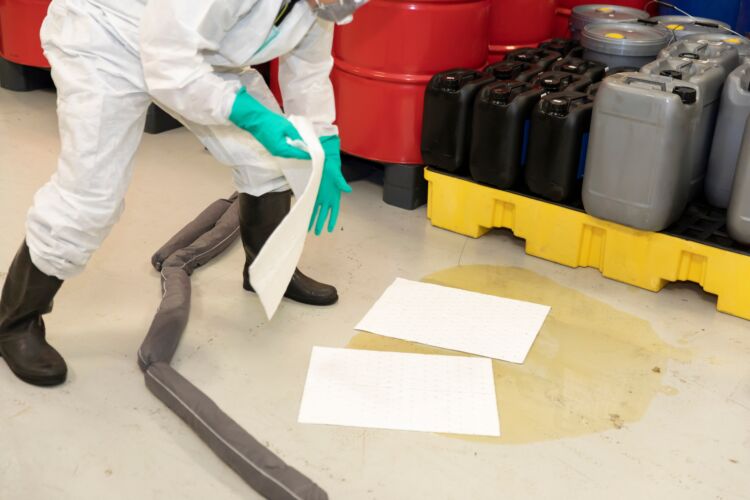
- Personal protective equipment (PPE) – nitrile gloves, goggles or face shields, protective overalls and chemical-resistant boots to keep responders safe.
- Containment aids – drain covers or socks to block floor drains, bunding blocks for small leaks and plastic sheeting to prevent contaminants spreading.
- Disposal bags – heavy-duty polyethylene bags, clearly labelled for hazardous waste, used to collect absorbents and other contaminated materials.
- Tools and accessories – scoops, brushes, dustpans and bin liners for safe cleanup. Larger kits may also contain small hand pumps or funnels to transfer liquids into secure waste containers.
- Instruction card – simple, step-by-step guidance tailored to the site’s most common spill types. This enables even untrained staff to respond quickly and correctly.
Advanced kits in labs or chemical environments may also include pH indicator strips, decontamination solutions and portable eye-wash bottles. Vehicle-mounted kits, used in delivery or transport settings, often feature absorbent booms, traffic cones and high-visibility vests to help secure the area and protect responders.
PPE for spill response: Choosing the right gear
PPE for spills must align with the spilled substance’s hazard profile. A risk assessment should pre-determine minimum PPE requirements for each material category. General spill-response PPE includes chemical-resistant gloves (nitrile, neoprene or butyl), splash-resistant goggles or full-face shields, and coveralls made of chemical-barrier fabrics.
For corrosive acid or alkali spills, responders need to wear heavy-duty, acid-resistant suits and boots rated to EN ISO 20345. Respiratory protection – such as half-mask cartridges or powered air-purifying respirators – may be necessary if vapours or dust exceed occupational exposure limits. Dust-tight goggles and disposable overboots help limit inhalation and cross-contamination when handling powdered materials.
Heat-resistant gloves and flame-retardant clothing are essential in environments where heated oils or combustible dusts pose a fire risk. In biological spills, additional barriers – such as disposable gowns, face masks and boot covers – prevent pathogen transfer. Hand-washing stations and emergency showers should be easy to reach so staff can clean up quickly and safely after removing their PPE.
Staff should be trained to put on and remove PPE correctly to avoid accidental contamination. Keeping clean equipment stored clearly and close to spill-risk areas helps ensure it’s always ready when needed.
Immediate response protocol: Step-by-step guide
A clear, rehearsed protocol is essential to minimise harm to people and the environment. The following sequence outlines a general response that can be adapted to site-specific risks and procedures:
- Raise the alarm and secure the area – notify nearby colleagues and, if required, the site emergency controller. Use barrier tape or cones to restrict access and keep bystanders away from the hazard zone.
- Put on appropriate PPE – refer to hazard data sheets (HDS) for the substance to confirm what protection level you need. Check gloves, goggles and clothing for damage before putting them on.
- Contain the spill at source – if safe, close valves, stop flow or upright toppled containers. Use drain covers to prevent liquids from entering sewers or surface water.
- Apply absorbents – surround the spill perimeter to form a containment barrier, then work inwards with pads or granular absorbents until the area is dry.
- Collect and dispose – use scoops or dustpans for solids and place all used absorbents in clearly labelled hazardous waste bags. Transfer recovered liquids into designated waste drums using funnels or pumps.
- Decontaminate and inspect – clean the affected area with suitable agents, then check for residue. Reapply absorbents if there are still traces of the spill.
- Remove and dispose of PPE – follow correct doffing procedures to avoid cross-contamination. Discard single-use items as hazardous waste.
- Report and record – complete an entry in the spill register, noting the substance, approximate volume, cause and response time. Notify site management and any relevant external bodies if required.
Regular drills help ensure these actions become second nature, allowing staff to respond quickly and confidently in real incidents.
Containment and clean-up techniques
Containment strategies focus on preventing spill migration. Portable bunds – foldable panels placed around spill areas – offer rapid deployment where fixed bunding is absent. Absorbent booms and socks encircle liquid spills, capturing fluids before they spread. In larger events, inflatable booms can isolate contaminated floor drain inlets.
For powder spills, misting with water (for non-water-reactive substances) reduces dust suspension. Industrial vacuum cleaners with HEPA filters collect powders safely, without dispersing particles. Dry sweeping is generally discouraged because it can generate dust. It’s only permitted under strict dust-control procedures.
Use of appropriate cleaning agents is essential. Detergents, degreasers and neutralising solutions make surfaces safe and remove any residual contamination that absorbents can’t capture. On textured or porous flooring, you might need to use mechanical scrubbing machines fitted with chemical-resistant pads.
Environmental considerations dictate disposal routes. Non-hazardous absorbents can enter general waste streams, while materials contaminated with hazardous chemicals must be managed via licensed waste contractors. Spill water from neutralisation processes may need to be pH tested before they are discharged into foul sewers, with consent from the water company.
Disposing of hazardous waste and environmental considerations
Once collected, hazardous residues must be disposed of safely and in line with legal requirements. Under the Environmental Protection Act 1990, businesses have a duty of care to ensure that waste is handed over only to authorised carriers – and accompanied by accurate transfer notes. These records detail the type, quantity and destination of each waste stream, meaning they are fully traceable from origin to disposal.
Proper segregation is essential to avoid dangerous reactions in storage or transport. Oxidising agents, for example, must never be stored with organic materials or acids. Clear labelling and colour-coded containers make it easier to keep waste organised and prevent it from being sent to the wrong facility.
Environmental responsibility also extends to handling spills near drains, waterways or ecologically sensitive areas, which may need to be reported to the Environment Agency immediately. In outdoor settings, absorbent booms can be deployed quickly to protect nearby watercourses. Post-incident soil testing confirms whether the area has been safely decontaminated.
Where possible, recovery and recycling help reduce environmental impact and disposal costs. Solvents, for instance, can often be reclaimed through on-site distillation units and reused in cleaning processes – supporting circular-economy goals and cutting waste at the source.
Special considerations: Oil, chemicals and biohazards
Different types of spills require specific control measures and equipment, as each substance presents unique risks to health, safety and the environment.
Oil spills
Oil spills, common in maintenance and manufacturing environments, create persistent slippery films and can degrade into toxic residues. Oil-specific absorbents, such as hydrophobic pads, repel water while soaking up hydrocarbons.
During outdoor leaks, floating booms or other containment barriers prevent oil from spreading into drains and waterways.
Chemical spills
How you manage a chemical spill depends on the substance involved. Acids and alkalis are neutralised by carefully applying granules while monitoring pH throughout the process. Organic solvents may require explosion-proof tools and intrinsically safe vacuums to reduce the risk of ignition. Highly reactive materials, such as peroxides, must be isolated, handled and disposed of only by licensed contractors.
Biohazard spills
Biohazard incidents, including spills of blood, bodily fluids or bacterial cultures, present infection risks and require strict containment. Dedicated biohazard spill kits typically contain disinfectant wipes meeting BS EN 1276 standards, biohazard waste bags, sharps containers and splash-proof face shields.
Cleaning must follow a two-stage process:
- Remove visible contamination with detergent and water.
- Apply disinfectant for the prescribed contact time.
Immediately place contaminated sharps into rigid, puncture-resistant bins.
High-containment laboratories
In labs handling high-risk biological materials, spill decks, biosafety cabinets and autoclaves provide controlled environments for managing contamination and ensuring that no infectious residue enters waste streams.

Reporting and recording incidents
A robust incident-reporting framework fosters continual improvement. Every spill – regardless of size – should be logged in a central register detailing date, time, substance, quantity, location, cause and response measures. This data facilitates trend analysis, helping identify recurring issues or systemic weaknesses.
Reporting thresholds should align with corporate and regulatory requirements. Significant spills, particularly those involving reportable quantities of hazardous substances or environmental release, may need to be reported to the Health and Safety Executive (RIDDOR) or the Environment Agency. Not reporting notifiable incidents can result in enforcement action.
Post-incident reviews – conducted by safety committees or investigators – analyse the circumstances around the spill, the effectiveness of the response and opportunities for prevention. Corrective actions, such as engineering upgrades or training refreshers, should be assigned ownership, with completion tracked and verified.
Publishing key performance indicators, such as number of spills per quarter and average response time, in safety bulletins promotes transparency and motivates your teams to continually improve.
Preparing staff to handle spills through training
Dealing with spills quickly and effectively requires people to know what to do and act fast.
Every new starter should be shown the basics — where spill kits are kept, who to call and how to stay safe in an emergency. Staff who handle chemicals or technical processes need deeper training that covers the materials they work with, how to choose the right PPE and how to decontaminate safely afterwards.
Training methods should be both theoretical and practical. Classroom sessions explain legislative context, risk assessment outcomes and site layouts. Hands-on drills, using inert simulants and empty spill kits, allow participants to rehearse containment and cleanup in realistic conditions. Regular refresher courses help keep skills sharp and ensure everyone’s up to date with the latest procedures.
Competency assessments – such as workplace observations or quizzes – verify that employees can articulate and execute the steps involved in spill response. Cross-functional drills, involving operations, maintenance and emergency teams, improve coordination and expose areas that need development.
Keeping clear records of who has completed training helps managers plan shifts confidently, knowing each team has people ready to handle a spill. Linking this to the site’s competence matrix also makes it easier for new staff to slot into emergency procedures quickly.
Maintenance and housekeeping best practices
Preventing spills begins with consistent maintenance and housekeeping, supported by modern monitoring technologies that detect problems before they escalate.
Routine inspection and upkeep remove many of the conditions that cause leaks. Scheduled checks of storage vessels, drum stands and piping detect wear, corrosion and loose fittings before failure. Regularly calibrating and testing automated dosing and dispensing systems keeps them accurate and helps prevent leaks before they start.
Good housekeeping also plays a critical role. Floors should be swept and mopped regularly to remove debris or small leaks that could cause slipping hazards. Shelving and racking must be properly secured and never overloaded to prevent top-heavy containers from tipping. Clear aisles make it easier to reach spill kits and evacuation routes quickly.
Maintenance records provide traceability and demonstrate due diligence. Sign-off sheets for completed inspections and repairs make sure the business is always ready for an audit. Replacing ageing containers – particularly those exposed to UV light or extreme temperatures – prevents brittle fractures and undetected leaks.
Using technology to monitor and prevent spills
Modern sensors and automation make it possible to detect leaks in real time and respond before they escalate. Liquid-sensor mats trigger alarms at the first sign of a spill, while infrared cameras pick up temperature changes that can indicate a failing seal. Automated shut-off valves linked to detectors can isolate an affected area within seconds, often before staff are even aware of the problem.
Remote-monitoring dashboards give a clear overview of tank levels and send alerts when something looks unusual, such as in the case of a slow leak or unauthorised access. Integrated management systems bring everything together, scheduling inspections, logging maintenance tasks and generating compliance reports automatically.
Mobile apps have also made spill management more practical on the ground. Staff can scan container barcodes for instant hazard information, ensuring the right spill kit is used without hesitation.
Data and analytics add a final layer of prevention. Reviewing incident records can uncover recurring problems, like repeated drum-handling errors in one area, helping managers focus training where it’s needed most. Predictive maintenance tools that track vibration or pressure changes can also spot early warning signs in pumps or pipes, preventing costly leaks and downtime.
Auditing and reviewing spill response plans
Regular audits help ensure that spill response plans still work in practice, not just on paper. A good audit looks at where spill kits are kept, whether equipment is in date, if PPE stocks are adequate and whether training records are up to date. Simulated spill drills are equally valuable, testing how well alarms, communication channels and teams respond under pressure.
External audits – carried out by consultants or local authority inspectors – bring a fresh perspective. They benchmark performance against recognised standards such as ISO 14001 for environmental management and ISO 45001 for health and safety. The findings should shape managers’ decisions about resources, priorities and long-term planning.
After every audit, clear action plans are essential. They should set out who is responsible for what, when tasks must be completed and how they will be funded. Follow-up checks then confirm that improvements have been made and that the site is better prepared for future spill events.

Summing up
Managing workplace spills effectively involves planning ahead, building safe habits and always being ready to act when something goes wrong. Good spill control combines prevention through design and training, quick and confident response, and a commitment to learning from every incident.
When these principles become part of everyday culture, organisations strengthen health, safety and environmental protection, while supporting operational continuity and regulatory compliance.