In this article
Lifting Operations and Lifting Equipment Regulations (LOLER) inspection frequency matters because thorough examination is both a legal minimum and a practical control. When lifting equipment fails, the outcome is rarely minor. Loads can drop, people can be struck or crushed, and businesses can face costly downtime, claims and enforcement action. The right interval is therefore not an admin detail. It is one of the main ways you can prove lifting equipment remains safe throughout its working life.
In the UK, the headline rule is simple: most lifting equipment is thoroughly examined at least every 12 months, while lifting accessories and equipment used to lift people are examined at least every 6 months. However, that is only the starting point. A written scheme of examination can set different periods, and certain events trigger extra examinations regardless of the calendar. The difference between a thorough examination and a routine inspection also matters, because many organisations accidentally do one and assume they have done the other.
This guide explains how often different types of lifting equipment and lifting accessories must be thoroughly examined, when the 6-month and 12-month rules apply, and when a written examination scheme can set different periods. It is aimed at duty-holders, facilities and fleet managers, maintenance teams, and contractors who need clear guidance for cranes, forklifts, hoists, mobile elevating work platforms (MEWPs), passenger and goods lifts, and lifting tackle. For official reference, start with the HSE overview ofLOLER and the Health and Safety Executive (HSE) page on thorough examinations and inspections of lifting equipment.
LOLER Inspection Frequency Explained
Under LOLER, ‘inspection frequency’ usually means how often you must arrange a thorough examination by a competent person. This is not a casual check. It is a systematic, independent assessment of the lifting equipment’s condition, installation (where relevant) and continued safety for use.
The legal requirement sits in Regulation 9, which sets out when thorough examination is required and the default maximum intervals. You can read the wording directly on legislation.gov.uk.
The purpose of these intervals is to stop deterioration from going unnoticed. Lifting equipment operates under load, cycles, shock, wear and environmental conditions that can degrade components. Even when equipment is maintained, it can still develop cracks, elongation, loose fasteners, corrosion, hydraulic leaks, control faults, or structural damage that only becomes obvious when checked properly.
It also helps to keep the scope clear:
- LOLER thorough examination is the legal periodic check (or scheme-based check) by a competent person.
- Routine inspection is the day-to-day or weekly style check carried out as part of your management system.
- Maintenance is the planned work that keeps equipment in a safe condition and prevents breakdowns.
You need all three. If you only rely on the thorough examination, you can miss defects that develop between examinations. If you only rely on routine checks and maintenance, you can miss deeper issues that require independent assessment.
In practice, businesses run into trouble when they treat ‘12 months’ as a target rather than a maximum interval. Put simply, you should plan examinations so they happen before the deadline, allow time for defects to be addressed, and avoid equipment being used out of date.
Is LOLER 6 or 12 Months?
The question “Is LOLER 6 or 12 months?” is common because many sites use a mix of equipment and accessories. The default answer is: both, depending on what the equipment is used for and what type it is.
The rule of thumb many duty-holders use is:
- 6 months for lifting accessories and for equipment used to lift people.
- 12 months for other lifting equipment used to lift loads only.
This aligns with HSE explanations of thorough examination and the typical default intervals.
However, two important points often get missed.
First, these are maximum intervals, not ‘best practice targets’. If equipment is heavily used, exposed to harsh environments, or shows repeated defects, a shorter interval may be appropriate.
Second, these default intervals can be replaced by a written scheme of examination drawn up by a competent person, which can set different frequencies based on risk, design, use patterns and deterioration mechanisms. That does not mean you can simply extend intervals to reduce cost. It means the interval is justified by a structured examination scheme and the competent person is satisfied it remains safe.
So when someone asks “6 or 12?”, the most useful response is: it depends on whether you are talking about accessories, lifting people or general load lifting equipment, and whether you are working to the default intervals or a written scheme.
Lifting Accessories: 6-Month Rule
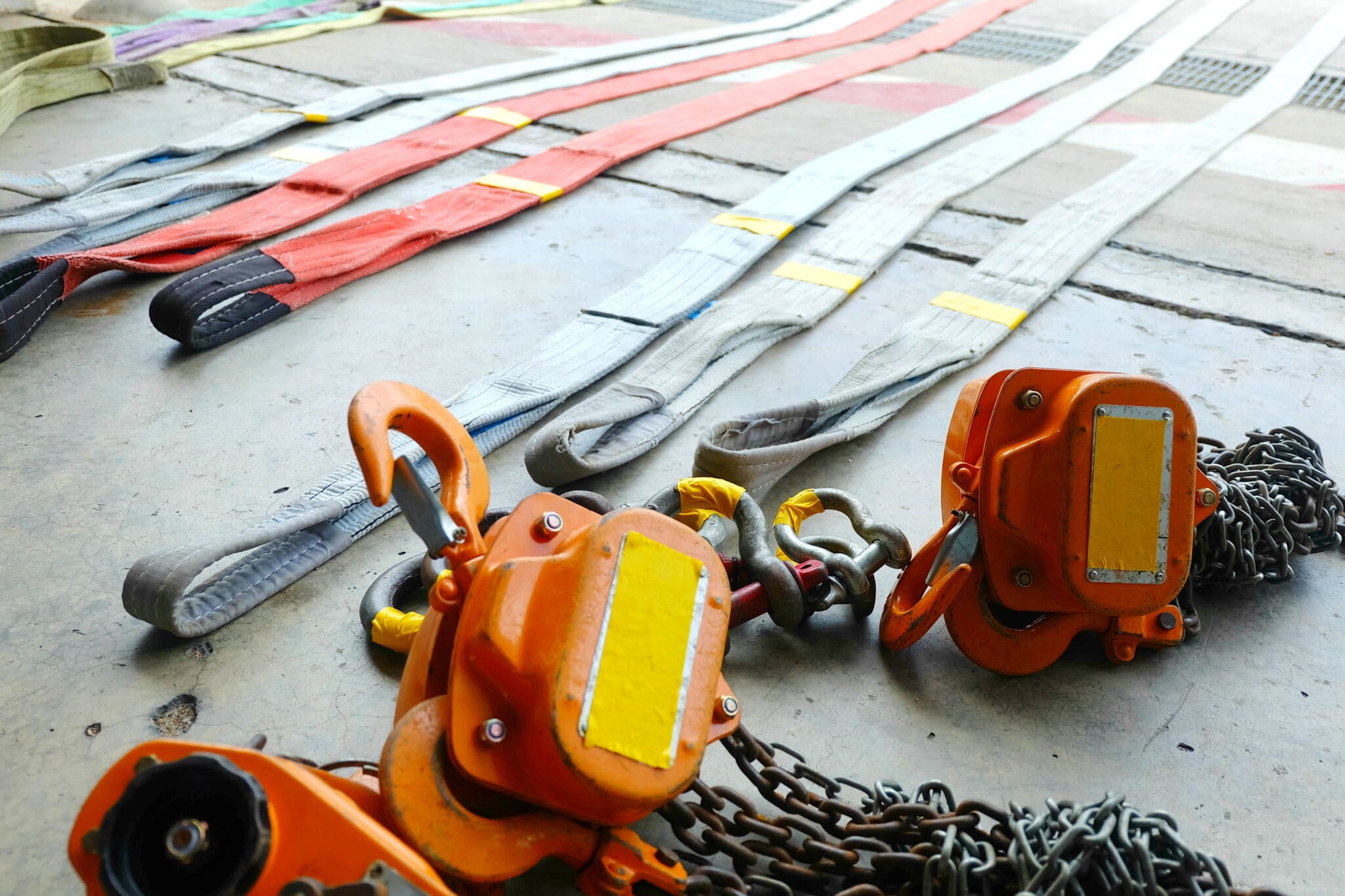
Lifting accessories are items used to attach a load to lifting equipment. They include slings, chains, shackles, eye bolts, hooks, lifting beams, spreader bars, clamps, magnets, vacuum lifters and other tackle. These items are often portable, frequently handled and easy to damage. They can also be mismatched, overloaded or used in poor configurations. Therefore, the default interval for thorough examination is at least every 6 months.
The HSE specifically highlights the need for records of thorough examinations and Declarations of Conformity for lifting accessories, which is often overlooked in practice.
A practical reason for the 6-month rule is that accessories deteriorate quickly through:
- Wear at contact points, especially hooks and links.
- Deformation from shock loading or misuse.
- Corrosion and pitting, particularly outdoors or in marine environments.
- Damage from cutting edges and hot work near slings.
- Illegible markings, making Safe Working Load (SWL) and identification unclear.
In day-to-day control, it is also useful to separate thorough examination from pre-use checks. Accessories might not need a separate ‘formal inspection’ regime beyond pre-use checks in some settings, but they do still need the standard thorough examination at the required interval.
Because accessories are often shared across departments and contractors, strong identification is essential. Many businesses reduce risk by adopting a simple rule: no ID, no use. That includes tag numbers, SWL markings and traceable examination records.
Lifting People: 6-Month Rule
If lifting equipment is used to lift or lower people, the default maximum interval for thorough examination is 6 months. This reflects the higher consequence of failure. A dropped load is serious. A fall involving a person is often fatal or life-changing.
Examples of lifting people include:
- MEWPs used to elevate workers.
- Man riding baskets or work platforms attached to cranes or forklifts.
- Passenger lifts in workplaces.
- Hoists designed to lift people.
- Some suspended access equipment.
The HSE treats lifting people as a distinct, higher-risk category within LOLER guidance and related lift guidance.
From a practical point of view, lifting people also increases the need for good planning and controls beyond the examination date. For example, if a MEWP is hired, you still need to ensure it is suitable for the ground conditions, that operators are competent, and that daily checks are done. The thorough examination certificate does not replace these controls.
It is also worth being careful with equipment that is primarily used for loads but occasionally used for people, such as a forklift with a work platform. If it is used to lift people, the 6-month rule applies to that use case, and you should also ensure the platform and attachment are suitable and examined as required.
If you manage multiple sites, a common improvement is to tag all ‘people lifting’ equipment clearly and manage it in a separate compliance list. That reduces the risk of applying the wrong interval due to assumptions.
Other Lifting Equipment: 12-Month Rule
For lifting equipment used only to lift loads, the default maximum interval for thorough examination is 12 months. This is the most common category and includes a wide range of equipment across industry, construction, logistics and facilities.
Typical examples include:
- Overhead cranes and gantry cranes.
- Goods hoists.
- Lifting beams and lifting machines fixed in plant.
- Vehicle tail lifts.
- Forklifts used for goods handling.
- Telehandlers when used for load lifting.
- Workshop hoists and engine cranes.
The HSE explains that thorough examinations should be at least every 12 months for lifting equipment, unless it is used to lift people or unless a written scheme specifies otherwise.
In practice, the ‘12 months’ rule often becomes complicated because sites use equipment in varying conditions. For example, a forklift might operate in a clean warehouse, while another operates outside in a corrosive environment, with uneven ground and frequent impacts. Both may be ‘forklifts’, but their deterioration risk is different.
That is where risk-based thinking matters. You may still comply with LOLER at 12 months, but you might decide to run more frequent routine inspections or more frequent preventive maintenance for higher-use or harsher-environment equipment.
Also note that other regulations and manufacturer requirements still apply. LOLER sets a minimum framework for thorough examination. It does not replace Provision and Use of Work Equipment Regulations (PUWER) duties to maintain equipment, or electrical safety requirements, or the need to control lifting operations properly.
Examination Scheme vs Fixed Intervals
LOLER allows thorough examinations to be carried out either at the default intervals or in accordance with an examination scheme. An examination scheme is a written plan drawn up by a competent person that sets out the scope and frequency of thorough examinations for specific equipment.
The value of a scheme is that it can reflect real risk. It might set a different interval based on:
- Duty cycles and intensity of use.
- Environmental exposure and corrosion risk.
- Known failure modes for that equipment type.
- Equipment age, condition and repair history.
- Criticality, such as safety-critical lifts or operations.
The concept is explained in HSE leaflet INDG422, which discusses the options for thorough examination and the benefits of an examination scheme.
A scheme can sometimes set longer periods, but that should be approached with caution. If a scheme extends an interval, you should be confident that routine inspections, maintenance and condition monitoring compensate and that the competent person’s judgement is properly documented. Many businesses find the more common outcome is the opposite: certain equipment ends up on shorter cycles because the scheme identifies higher deterioration risk.
A practical way to use a scheme well is to treat it like an engineering control rather than a paperwork exercise. It should be reviewed when conditions change, such as new operating patterns, repeat defects or relocation. It should also align with your maintenance strategy so that thorough examination findings feed into planned work rather than creating last-minute reactive repairs.
Thorough Examination vs Routine Inspection
This is one of the most important distinctions for duty-holders. If you confuse these terms, you can be ‘doing checks’ and still be non-compliant.
A thorough examination is carried out by a competent person and is a LOLER requirement. It results in a report that includes prescribed information and triggers formal defect reporting requirements.
A routine inspection is typically carried out by operators, supervisors or maintenance teams. It can be daily, weekly or task-based. Its purpose is to spot obvious damage, confirm safety devices work, and remove unsafe equipment from service before use.
HSE guidance makes it clear that thorough examination is not a substitute for checks before use and ongoing inspection arrangements.
In plain terms, thorough examination answers “Is this lifting equipment still safe in principle and condition, based on an independent assessment?” Routine inspection answers “Is this equipment safe to use right now, for this task, under these conditions?”
A strong compliance approach uses both. For example, you might:
- Require pre-use checks for slings and shackles before every lift.
- Require weekly recorded checks for forklift mast chains and forks.
- Arrange LOLER thorough examinations at 6 or 12 months.
- Use maintenance records and defect trends to target high-risk items.
This layered approach reduces failure risk far more than relying on any single control.
After Installation: When Examinations Apply
Some lifting equipment must be thoroughly examined after installation and before first use if safety depends on installation conditions. This is especially relevant to equipment that is fixed, assembled or installed on site.
Regulation 9 includes the requirement for thorough examination after installation and before being put into service for the first time where safety depends on the installation conditions.
In practical terms, this often applies to:
- Overhead cranes and runway systems.
- Fixed hoists and lifting machines.
- Passenger and goods lifts.
- Fixed lifting beams and permanent lifting points.
- Some complex lifting systems with anchors or structural supports.
The purpose is to confirm the equipment has been installed correctly, that the supporting structure and fixings are suitable, and that safety devices operate properly in the installed configuration. Manufacturer documentation and commissioning checks may be involved, but the LOLER thorough examination is still required where the regulation applies.
A common pitfall is assuming that a ‘new equipment’ certificate or commissioning paperwork replaces the thorough examination. In reality, you should make sure your compliance file contains what you need: installation records, Declaration of Conformity where relevant, and the required examination report where applicable.
If you are buying or installing new equipment, build this into the project plan. It avoids the awkward situation where equipment is installed and operators are ready, but the equipment cannot legally be used because the post-installation examination was not arranged.
After Reassembly or Relocation Requirements
Lifting equipment that is assembled and then used at a new site or in a new location may require a thorough examination after reassembly and before being put into service, where safety depends on installation conditions.
Regulation 9 explicitly includes examination after assembly and before being put into service at a new site or in a new location where installation conditions matter.
This matters for equipment such as:
- Tower cranes and mobile cranes assembled on site.
- Temporary gantry systems.
- Lifting beams and runway systems relocated within a facility.
- Equipment moved between warehouses, including fixed hoists.
Even within the same site, relocation can change load paths, floor loading, anchoring and structural interactions. For example, moving a jib crane to a different bay may change the supporting steelwork and introduce different dynamic effects. A competent person needs to confirm the system remains safe in the new configuration.
For fleet and facilities managers, the practical control is to treat relocation like a trigger event. Build a simple relocation checklist that asks:
- Has the equipment been dismantled or reassembled?
- Does it rely on anchors, supports or structural fixings?
- Has the location changed load distribution or operating conditions?
- Has the competent person been notified and scheduled?
This avoids missed examinations caused by ‘it’s the same crane, just moved a bit’.
Exceptional Circumstances: When to Re-Examine
LOLER requires thorough examination after exceptional circumstances that are liable to jeopardise the safety of lifting equipment. This is a key practical safety net, because it recognises that equipment condition can change suddenly due to events, not just time.
Exceptional circumstances can include:
- Overload incidents.
- Collisions, impacts or dropped loads.
- Structural damage, such as bent forks or boom damage.
- Exposure to fire, extreme heat or chemical attack.
- Major modifications or repairs that affect load-bearing parts.
- Long periods out of use where deterioration may have occurred.
- Severe weather events affecting outdoor cranes and lifting gear.
The HSE position is that you should ensure thorough examination takes place in these circumstances, because the normal interval does not protect you against event-driven damage.
In practice, you should also define what ‘exceptional’ means for your operations. For a warehouse, a forklift collision that damages the mast may be exceptional. For a heavy engineering site, a shock load event on a crane may be the trigger. The key is to create a reporting culture where people feel expected to flag incidents, not hide them to avoid delays.
A useful rule is: if the incident would worry you if you were standing under the load next time, treat it as a trigger for competent review and, where appropriate, thorough examination.
Who Can Carry Out LOLER Examinations?
LOLER thorough examinations must be carried out by a competent person. Competence is not simply a job title. It is the ability to identify defects, assess their significance, understand failure modes, and make sound judgements about continued safety.
A competent person should have:
- Sufficient technical knowledge of the equipment type.
- Practical experience of examination and defect identification.
- Independence and impartiality to make objective decisions.
- Access to information, standards and methods relevant to the equipment.
In practice, competent persons may be:
- Independent inspection bodies.
- Specialist engineering inspection companies.
- Manufacturers’ competent inspectors (where appropriate).
- In-house competent persons, if truly competent and sufficiently independent.
The independence point matters. If the same person is responsible for production output and is pressured to keep equipment running, their judgement may be compromised. Many organisations therefore use external competent persons for high-risk equipment, while maintaining strong internal routine inspection and maintenance.
If you appoint a provider, ask practical questions:
- Which equipment types are they competent to examine?
- What standards and guidance do they work to?
- How do they classify defects and set actions?
- How quickly do they issue reports, especially for critical defects?
- How do they handle escalation and statutory reporting?
Choosing competent examination is not only about compliance. It is a business protection measure. A poor examination that misses defects can cost far more than the examination fee.
LOLER Reports: What Must Be Included
A thorough examination produces a report, and that report is part of your compliance evidence. It also drives safety actions. If the report is vague, late or missing key details, it becomes hard to manage defects and demonstrate control.
HSE guidance emphasises keeping records of thorough examinations and related documentation such as Declarations of Conformity for lifting equipment and accessories.
While report formats vary, the report should clearly identify:
- The equipment examined, including unique ID and description.
- The location and duty-holder details.
- The date of examination and the date the next examination is due.
- The parts examined and the nature of the examination.
- Any defects found and their significance.
- Any tests carried out, where relevant.
- Clear recommendations or required actions.
- Any requirement to stop using equipment if unsafe.
A practical point that helps in audits is to ensure the report ties to your asset register. If an examiner writes “chain block in workshop” but you have five chain blocks, you have created uncertainty. Clear identification avoids that.
It is also good practice to store reports in a way that is usable at the point of planning. For example, keep a compliance dashboard or register that shows what is in date, what is due and what defects are open. This reduces missed deadlines and prevents equipment from being used out of compliance without anyone realising.
Defects, Actions and Reporting Deadlines
Defect management is where compliance becomes real. A report that finds a serious defect should trigger immediate control, not a slow admin process. LOLER includes specific expectations about defect reporting, especially where defects present an existing or imminent risk of serious personal injury.
In practice, you should treat defects in three bands:
- Immediate danger: Equipment must be taken out of service immediately.
- Significant defect: Repair or remedial action required within a specified timescale, often before next use or before a defined deadline.
- Minor defect or observation: Monitor or address through planned maintenance.
The HSE guidance on thorough examinations highlights the importance of records and defect actions.
To make this work day to day, your system needs clear ownership and tracking. A simple approach is:
- Assign each defect to a named owner.
- Set a due date aligned with the examiner’s requirement.
- Confirm equipment status, such as quarantined, restricted use, or safe to use with controls.
- Verify completion, not just ‘work raised’.
- Keep evidence, such as repair notes, photos, parts replaced and sign-off.
Common failures include closing actions without verifying the defect is actually resolved, or allowing equipment back into service because operations are under pressure. These failures often show up after incidents.
A robust system treats defect closure as a safety-critical step. It also uses defect trends to improve prevention. If the same defect repeats, ask why. Is equipment being misused? Is the environment causing corrosion? Is maintenance inadequate? Is training weak? Fixing root causes reduces both risk and cost.
Common LOLER Compliance Mistakes
Most LOLER failures are avoidable. They usually happen because responsibility is unclear, equipment lists are incomplete, or people rely on assumptions.
Common mistakes include:
- Applying the wrong interval, such as treating accessories as 12-month items.
- Forgetting that equipment used to lift people is on a 6-month cycle.
- Missing examination after relocation or reassembly.
- Not triggering extra examination after an incident or overload.
- Poor equipment identification, leading to the wrong item being examined.
- Missing Declarations of Conformity for new accessories.
- Treating a service or maintenance visit as a LOLER thorough examination.
- Using equipment out of date because scheduling was left too late.
- Failing to track defects to completion and allowing continued use.
- Assuming hired equipment is always compliant without checking documentation.
A practical way to reduce these errors is to keep one master lifting equipment register that includes both equipment and accessories, clearly categorised by interval and use type.
Many organisations also find it useful to colour-code compliance lists, such as:
- People lifting equipment.
- Accessories.
- General goods lifting equipment.
Then link this register to your procurement and contractor processes. When new equipment arrives, it should not enter service until it is added to the register, identified and supported by the right documents.
Finally, make sure supervisors understand what they are looking at. If they know the difference between thorough examination and routine inspection, they are far less likely to be misled by paperwork that ‘looks official’ but does not meet the requirement.
Conclusion
LOLER inspection frequency is not a minor admin detail. It is a legal minimum and a core safety control that prevents lifting failures and protects people and businesses. The default rule is straightforward: lifting accessories and equipment used to lift people are thoroughly examined at least every 6 months, while other lifting equipment used for loads is examined at least every 12 months. A written scheme of examination can set different periods, and extra examinations are required after installation (where safety depends on installation), after assembly and relocation, and after exceptional circumstances that could jeopardise safety.
The best results come from treating thorough examination as one layer in a wider system. Combine LOLER examinations with routine inspections, planned maintenance, strong defect tracking, and clear equipment identification. Use a single lifting register, plan examinations ahead of deadline, and trigger extra examinations when events occur. If you want to cross-check your approach against recognised guidance, start with the HSE pages on LOLER and thorough examinations of lifting equipment, then make sure your local process turns those requirements into consistent, visible control on the ground.