
In this article
Higher-risk jobs can go wrong in minutes. A single spark can ignite vapour. A valve left open can refill a vessel. A contractor can start work on the wrong isolation point. In busy workplaces, people also make assumptions, especially when the job feels routine. A permit to work (PTW) system exists to stop those assumptions from turning into injuries, fires, explosions, releases or costly downtime.
A PTW system is not a form that ‘makes work safe’. Instead, it is a practical control that makes sure the right hazards have been identified, the right isolations are in place, the right people understand the plan, and someone competent has authorised the job. Done well, it improves contractor control, reduces rework, and creates a clear audit trail for clients, insurers and regulators. Done badly, it becomes a paperwork exercise that frustrates teams and still lets incidents through.
This guide explains what a permit to work is, when it is required, and how to issue, accept, manage and close permits without adding unnecessary bureaucracy. It focuses on common UK permit types such as hot work, confined space entry, electrical work, line breaking, and work at height. For a solid baseline, many organisations refer to the Health and Safety Executive (HSE) publication Guidance on permit-to-work systems (HSG250), plus the HSE overview of risk assessment and risk control.
What is a Permit to Work?
A permit to work is a formal, written system used to control certain types of work that carry a higher risk. It sets out the job, the hazards, the controls, and the boundaries of what is authorised. It also records who is responsible for each step and what must happen before work starts, while work is underway, and when the job ends.
A permit works best when it acts like a pause button on normal routine. It forces people to confirm key safety-critical details instead of relying on memory.
In plain terms, a permit to work answers six questions:
- What work will we do, and where will we do it?
- What could harm people, plant or the environment during that work?
- What controls must be in place before we start?
- Who has checked and authorised those controls?
- Who will do the work and who will supervise it?
- When does the authorisation start and end?
A PTW is most useful where mistakes have severe consequences or where several controls need coordination. That includes jobs with multiple isolations, jobs with changing conditions, and jobs where workers cannot easily escape danger, such as confined spaces.
A permit is also a communication tool. It gives site teams, contractors and managers a shared view of what is happening, what is isolated and what is prohibited. As a result, it reduces conflicting work, like hot work near a flammable release point, or energising a circuit while someone still works downstream.

When is a Permit Required?
Not every job needs a permit. If you issue permits for everything, people stop taking them seriously. On the other hand, if you avoid permits to keep work moving, you increase risk and often lose more time later through incidents and rework.
Use a permit when the work has a credible potential for serious harm and when your controls depend on correct sequencing and verification.
In many UK workplaces, permits are required for tasks such as:
- Hot work, including welding, cutting, grinding, and any work that creates sparks or heat.
- Confined space entry, including tanks, pits, sewers, ducts and voids where conditions can change.
- Electrical work, including isolation, testing, and work on or near live systems where justified.
- Line breaking, including opening pipelines, hoses and vessels that may contain hazardous substances or pressure.
- Work at height, especially where fragile surfaces, complex access or rescue planning is involved.
- Excavations, especially near services, structures or contaminated ground.
- Work on safety-critical systems, such as fire systems, gas detection, interlocks and emergency shutdowns.
- Simultaneous operations, where one task can create risk for another task nearby.
A practical rule is to ask: “If we get this wrong, could someone be killed or seriously injured, or could we trigger a major fire, explosion, release or collapse?” If the answer is yes, a permit often helps.
Permits are also useful when the site has strict client requirements. For example, principal contractors often require hot work permits even for small tasks because they need consistent control across many trades.
Permit to Work vs Risk Assessment
People often confuse a permit to work with a risk assessment. They are linked, yet they are not the same. A risk assessment identifies hazards and selects controls. A permit controls the execution of a specific job at a specific time and place.
When you mix the two up, you either create a permit that is too generic, or you create a risk assessment that does not translate into action on the day.
Think of it like this:
- Risk assessment: “What could go wrong in this task, and what controls do we need in general?”
- Permit: “Have we put those controls in place today, in this location, with these people, and have we verified them?”
A risk assessment can cover a task type, such as ‘hot work on handrails’. It can also cover a process, such as ‘electrical isolation and test’. It should not change every day unless conditions change.
A permit is job-specific. It should reflect the actual work area, the current plant status, other work happening nearby, and the people involved. It should also capture anything that changed since the risk assessment was written, such as new materials, a temporary enclosure or a ventilation failure.
In practice, most organisations link the two by referencing the relevant risk assessment or method statement on the permit. The permit then confirms the controls are in place and lists any additional job-specific precautions.
This approach also supports audit and assurance. It shows you do not rely on paper alone. You use risk assessment to design controls, then you use the permit to confirm and enforce them in real time.
Permit to Work Roles and Responsibilities
A permit system only works when responsibilities are clear. If everyone assumes someone else checked the isolation, nobody checked it. If everyone thinks the contractor ‘owns’ the permit, the site may lose control of safety-critical boundaries.
Most permit systems use a small set of roles. The exact titles vary, yet the responsibilities should stay consistent.
Common roles include:
- Authorising person: The competent person who issues the permit and confirms controls. This person has the authority to approve work and stop it.
- Performing authority: The person in charge of the work team, often a supervisor or lead contractor. This person accepts the permit and makes sure the team follows it.
- Permit issuer: In some systems, the issuer and authoriser are different. The issuer prepares the permit, while the authoriser signs it off.
- Area owner: The person responsible for the plant or area. This person confirms the area status and agrees the job can proceed.
- Isolating authority: The competent person who carries out isolations and proves them. In complex sites, this role is separate to avoid shortcuts.
- Standby person: For confined space entry, a trained attendant who remains outside and monitors the entrant.
- Safety watch: For hot work, a person who monitors fire risk during and after the work, where required.
You should also define the responsibilities of contractors clearly. Contractors must follow site rules, yet the duty-holder still must manage risks. A clear contractor control process, supported by permits, can prevent misunderstandings at the boundary between site and contractor.
A useful habit is to build stop authority into every role. Anyone should be able to pause the job if conditions change, alarms sound or the permit no longer reflects reality.
How to Write a Permit to Work
A permit should be short enough that people read it, yet detailed enough that it controls risk. The goal is clarity, not volume. Most strong permits follow a consistent structure and use plain language.
Start with the basics:
- Job title and permit number.
- Exact location, including plant ID and access point.
- Description of work, written in active steps.
- Names of people and companies involved.
- Start and end time window for the authorisation.
Then build the control core:
- Hazards present in the area, such as flammables, moving plant, pressure and traffic.
- Specific controls required, such as isolation points, barriers, ventilation, monitoring and PPE.
- Prohibited activities, such as smoking, hot work or energising systems.
- Required checks, such as gas test results, lockout verification and access inspection.
Finally, add the operational features:
- Briefing confirmation, including who received the briefing.
- Toolbox talk requirement if conditions are complex.
- Handover rules for shift change.
- Emergency arrangements and rescue plan references.
- Suspension and revalidation steps.
- Close-out steps and reinstatement checks.
Write controls as actions, not as slogans. “Wear PPE” is too vague. “Wear chemical resistant gloves and face shield when breaking the line” is clearer. “Ensure isolation” is also vague. “Lock and tag valve V-103 closed, apply blind at flange F-7, and prove zero energy” gives a clear standard.
Also keep the permit aligned with the method statement. If the method says “use a non-sparking tool”, the permit should not allow a grinder.
Permit to Work Checklist
A checklist helps permit issuers and work teams avoid missed steps. It also improves consistency across different supervisors and sites. The checklist below is written for UK workplaces, yet it suits most sectors.
Before issuing:
- Confirm the work scope and exact location.
- Confirm the relevant risk assessment and method statement are current.
- Check whether other permits or simultaneous operations affect the job.
- Identify energy sources and substances connected to the work area.
- Decide what isolations, barriers and controls are needed.
Isolation and preparation:
- Isolate all energy sources, including electrical, mechanical, hydraulic, pneumatic, thermal and process flow.
- Apply lockout and tagout and control keys.
- Prove isolation is effective, not only ‘switched off’.
- Drain, vent, purge and clean systems where needed.
- Confirm safe access, lighting and housekeeping.
Atmosphere and ignition control where relevant:
- Test atmosphere if flammables, toxic gases or oxygen deficiency is possible.
- Record results, location, time and tester name.
- Provide ventilation if required and confirm it remains effective.
- Control ignition sources, including tools, phones and temporary power.
Briefing and authorisation:
- Brief the performing team and confirm understanding.
- Confirm competence, including specific training for confined space or electrical work.
- Confirm PPE and equipment are suitable and in good condition.
- Confirm emergency arrangements and rescue plan, including communications.
- Issue and sign the permit, then display it as required.
During work:
- Monitor conditions and verify controls stay in place.
- Stop work if the scope changes or controls fail.
- Manage breaks, temporary exits and changes in personnel.
- Keep the work area tidy and maintain safe access.
Close-out:
- Confirm the job is complete and the area is safe.
- Remove tools, waste and temporary barriers as planned.
- Confirm isolations can be removed safely and systems reinstated.
- Record any defects, lessons and follow-up actions.
- Close the permit and file it correctly.
This checklist should sit alongside your site rules. It should also be supported by training and supervision, otherwise it becomes a tick list with no meaning.
Hot Work Permit Requirements
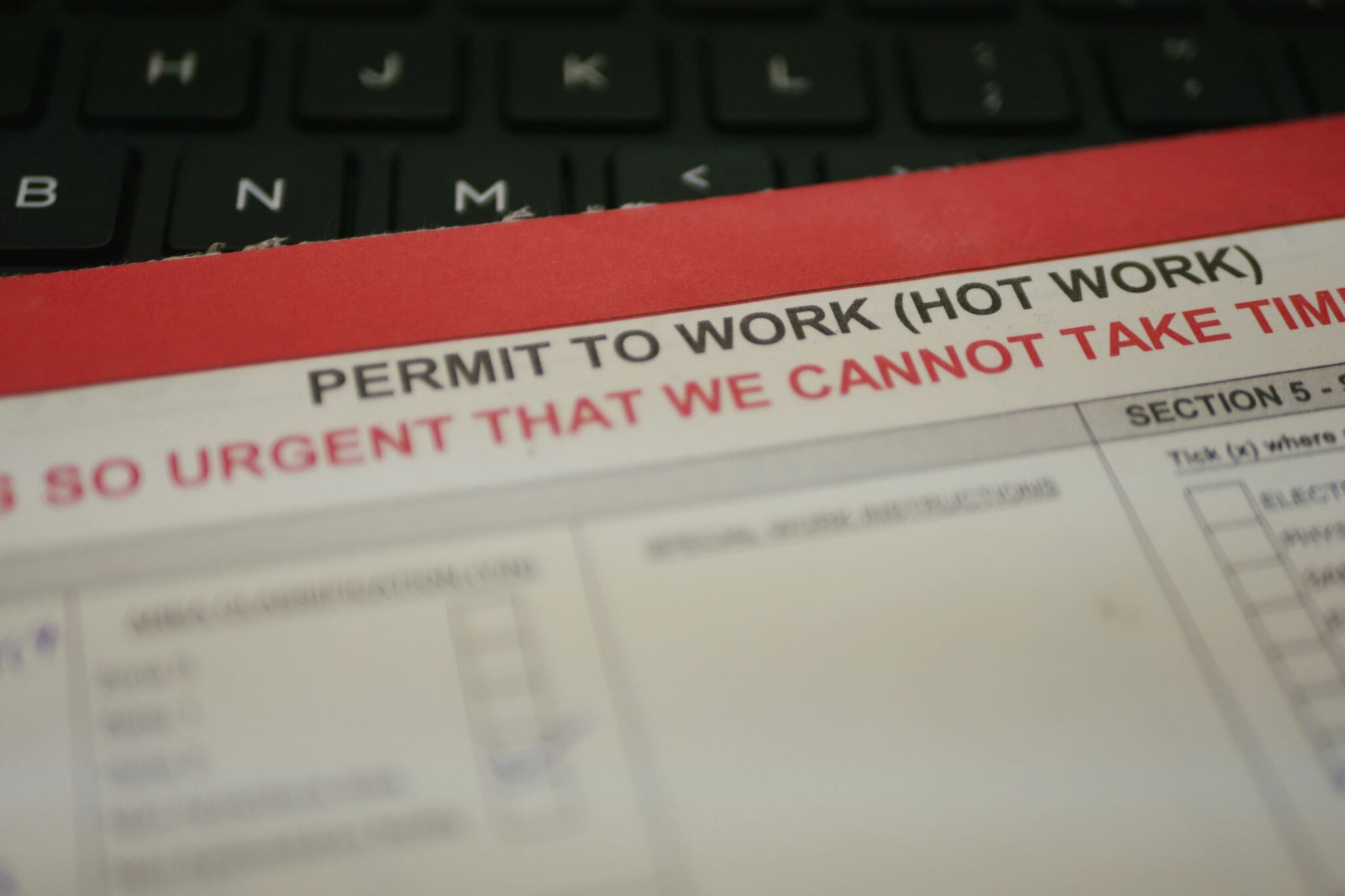
Hot work is one of the most common reasons for a permit because ignition sources and hidden combustibles can combine quickly. Hot work includes welding, cutting, brazing, soldering, grinding, and any work that produces heat, sparks or flames.
Hot work permits do not replace fire safety measures. They provide a structured way to control ignition sources in the specific location and time window.
A practical hot work permit should cover:
- Confirmation that hot work is necessary and that safer alternatives were considered, such as cold cutting or mechanical fastening.
- Inspection of the work area for combustibles, including behind panels, under floors, inside ducts and above ceilings.
- Removal of combustibles where possible and shielding where removal is not possible.
- Control of flammable liquids, gases, dusts and vapours in and near the work area.
- Gas testing where vapours may be present, especially in plant areas and near drains or pits.
- Fire watch arrangements during work and for a defined period after work ends.
- Availability of suitable fire extinguishers and trained users.
- Protection of detectors and sprinkler heads only where authorised and with strict reinstatement control.
- Management of sparks travel, including use of screens and spark containment.
- Clear stop rules, such as “stop if ventilation fails or if a flammable alarm activates”.
Many organisations also require a post-hot-work check at set intervals to catch smouldering fires. The appropriate duration depends on the environment. For guidance on hot work risk, organisations often refer to fire sector advice, such as the Fire Protection Agency hot work safety guidance.
In Dangerous Substances and Explosive Atmospheres Regulations (DSEAR) environments, hot work control becomes even more critical. If flammable atmospheres are possible, you must control both release sources and ignition sources. The HSE guidance on DSEAR helps duty-holders understand this link.
Confined Space Entry Permit Example
Confined space work needs a permit because conditions can change quickly and because escape and rescue are difficult. A permit supports safe entry by making isolation, testing, ventilation and rescue planning visible and verifiable.
For UK baseline guidance, many teams use HSE safe work in confined spaces (INDG258) as a reference.
A practical confined space entry permit will usually include:
- Space identification: Tank number, manhole ID, pit location and access route.
- Purpose of entry: Inspection, cleaning, repair, sampling or installation.
- Hazards: Oxygen deficiency, toxic gases, flammable atmosphere, engulfment, flooding, moving equipment and heat stress.
- Isolations: Mechanical isolation of inlets and outlets, lockout of mixers and pumps, blanks fitted and drains controlled.
- Cleaning and preparation: Draining, rinsing, purging and confirmation that residues are controlled.
- Atmosphere testing: Oxygen, flammables and relevant toxics, with results recorded and retest frequency stated.
- Ventilation: Type, location of ducting, and confirmation ventilation will run continuously.
- Entry controls: Entry log, maximum number of entrants, communications method, lighting and PPE.
- Rescue plan: Retrieval equipment, standby person, rescue team arrangements and emergency contact route.
- Time limits: Entry duration, breaks and criteria for stopping.
- Handover: Rules for shift change, including revalidation and retesting.
A strong permit also defines no entry triggers. For example:
- Gas monitor alarms.
- Loss of ventilation.
- Flooding risk increases or water level changes.
- Communication failure.
- Change in work scope, such as introducing hot work.
Confined space rescue is where many sites fail. A permit must point to a realistic rescue plan, not a hope that someone will ‘go in after them’. Retrieval systems, training and a practised plan are key. A permit helps enforce that by making rescue a condition of entry.
Electrical Isolation Permit Explained
Electrical work carries high risk because faults and energisation errors can kill. A permit helps control isolation, testing and re-energisation, especially in complex sites where several teams work on interconnected systems.
A good electrical permit does not encourage unnecessary live work. Instead, it supports safe isolation and verification. For a useful reference point, many teams refer to the HSE guidance on Electrical safety at work and the legal duties under the Electricity at Work Regulations.
An electrical isolation permit should cover:
- Circuit identification: Panel, breaker, feeder and equipment ID, with drawings referenced.
- Work description: What work will be done, and what boundaries apply.
- Isolation points: Switches, breakers, fuses and disconnects, including secondary feeds.
- Lockout: Locks applied, tags fitted, key control and who holds keys.
- Prove dead: Test method, tester verification and confirmation of no voltage.
- Stored energy: Capacitors, UPS supplies and motor backfeed, with discharge steps.
- Adjacent live parts: Barriers, covers and safe approach distances where relevant.
- Tools and PPE: Insulated tools, arc rated PPE where justified, and testing equipment.
- Re-energisation: Checks before power restoration, warnings and who authorises restart.
- Communication: Who must be informed before energising, including contractors and area owners.
Electrical permits also need strong shift handover rules. A half finished isolation is a common failure point. A permit system that forces revalidation at shift change reduces that risk.
If your site uses high voltage, complex switchgear or hazardous areas, you may also need specialist authorisation levels and more detailed switching schedules. The permit still provides the one source of truth for who can do what, when.
Line Breaking Permit Steps
Line breaking means opening a pipe, hose, vessel or system that could contain hazardous substances, pressure, heat or stored energy. It is a frequent cause of chemical burns, inhalation exposures and environmental releases. People also underestimate it because it can look like routine maintenance.
A line breaking permit makes sure the line is isolated, depressurised, drained, purged where needed, and safe to open.
A practical line-breaking permit sequence includes:
- Confirm the substance: Identify what is in the line, including any residues, and review the Safety Data Sheet (SDS) and Control of Substances Hazardous to Health (COSHH) assessment where applicable. The HSE guidance on COSHH supports this step.
- Identify boundaries: Define exactly which section will be opened and what connects to it.
- Isolate: Close and lock relevant valves, apply blinds or spades where required, and control drains and vents.
- Depressurise: Vent safely to a suitable location and confirm pressure is zero.
- Drain and purge: Drain contents to a safe container or system. Purge with inert gas or water where required, while controlling oxygen deficiency risks.
- Verify: Prove isolation and prove line condition, such as no pressure, no flow, and safe atmosphere at opening.
- Prepare containment: Set drip trays, absorbents, bunding and waste containers.
- Choose PPE: Match PPE to the hazard, including face protection for splash risk and RPE where vapours may be present.
- Open slowly: Crack fittings gradually to confirm no residual pressure or unexpected release.
- Control ignition: If flammable substance is possible, control ignition sources and consider gas monitoring.
- Restore safely: After the job, reassemble, pressure test where required, and reinstate valves with a controlled start-up.
Line breaking is also a good example of why permits reduce rework. If you open the wrong line, you create a release and a major clean-up. Clear identification and authorisation reduces that risk.
Permit to Work Handover and Shift Change
Shift change is one of the highest risk moments for permit controlled work. Information can be lost, assumptions can creep in, and new teams may not understand why controls are in place. If you manage permits across shifts, you need a strict handover method.
Strong handover practice includes:
- A face-to-face handover between outgoing and incoming supervisors where possible.
- A review of the permit scope, status, and any changes during the shift.
- A physical check of isolations, barriers and controls, not only a signature.
- Confirmation of who is inside the area, including contractors.
- Revalidation of critical checks, such as gas tests for confined spaces or hot work control.
- Clear rules about personnel changes, such as briefing new entrants before they start.
- A pause in work during handover so people do not work while responsibilities are unclear.
Many sites use a simple rule: a permit is not ‘handed over’ automatically. The incoming authorised person must accept responsibility actively. If they cannot confirm controls, they should suspend the permit until they can.
If your site uses a 24 hour operation, consider a permit control board or digital system that shows all live permits and their status. Visibility reduces the chance of conflicting work and makes handover easier.
Permit Display, Briefing and Toolbox Talks
A permit only protects people if they know what it says. That sounds obvious, yet it is a common failure point. People often sign to accept a permit and then brief the team poorly, especially when they feel rushed.
The permit process should build in a clear briefing step, and it should make the permit visible where the work happens.
Practical good practice includes:
- Display the permit at the point of work, or in a visible permit station that the team uses before entry.
- Brief the team on the hazards, controls and stop rules, using the permit as the script.
- Confirm understanding by asking questions, not by reading out loud and hoping people listened.
- Use a toolbox talk when the work is complex, conditions change or several trades work together.
- Capture names of those briefed and ensure late arrivals receive the same briefing.
- Use simple diagrams or photos for complex isolations or boundaries.
Toolbox talks should support the permit, not replace it. A talk is a communication tool. The permit is the authorisation and control record. When you align them, you reduce confusion. When you separate them, you risk mixed messages.
If you want a credible external reference for toolbox talks and worker engagement, NBS provides a useful overview of toolbox talks.
Permit Duration, Suspension and Extensions
Permits should never run indefinitely. A long running permit becomes invisible. People stop reading it and start assuming it still applies. Good systems control permit duration and include clear rules for suspending and extending work safely.
A practical approach includes:
- Set a clear start and end time, often within a single shift for higher-risk work.
- Require revalidation for extensions, including rechecking critical controls.
- Suspend the permit if conditions change, such as weather changes for outdoor work, ventilation failure or nearby operations change.
- Suspend the permit during breaks if the site rules require it, especially for hot work or confined space entry.
- Cancel and reissue if the scope changes. Do not edit scope casually on a live permit without a controlled review.
Suspension is a safety tool, not a punishment. It lets teams pause when reality no longer matches the plan. A good culture supports this. It also avoids the common issue of stretching a permit to cover new tasks, which weakens control and accountability.
Extensions should be rare for the highest risk jobs. If you keep extending a permit, ask why. Perhaps planning was poor, or the job scope was unclear, or the team needs more resources. In those cases, the permit process has highlighted a management issue that you can fix.
How to Close Out a Permit
Close-out is where many permits fail. People focus on starting work safely and forget the risks of finishing. Re-energisation, reinstatement and returning a plant to service can create hazards if the team leaves tools in place, removes barriers too soon or restores systems without checks.
Close-out should be as disciplined as issue.
A strong close-out includes:
- Confirm the work is complete and that the area is clean and safe.
- Remove tools, materials and waste, including temporary lighting and cables.
- Remove temporary protections only when safe, such as fire blankets and screens.
- Confirm guards, covers and interlocks are reinstated where required.
- Confirm isolations can be removed safely and in the correct sequence.
- Communicate with affected parties before re-energising or returning flow, including contractors and area owners.
- Perform functional checks where required, such as leak tests after line breaking or test runs after mechanical work.
- Record any defects found, deviations or follow-up work needed.
- Close the permit formally and file it according to your retention rules.
Close-out is also a learning moment. If the job revealed a weak isolation point, a confusing label or an access problem, capture it. Those details improve the next permit and reduce future risk. Over time, this creates continuous improvement without adding complexity.
Common Permit to Work Mistakes
Most permit systems fail in predictable ways. If you know the patterns, you can design the process to prevent them. The goal is not to blame individuals. The goal is to build a system that makes the safe way the easy way.
Common mistakes include:
- Issuing permits for routine low-risk work, which creates permit fatigue and reduces attention.
- Writing vague controls, such as ‘take care’ or ‘use PPE’, instead of specific actions.
- Failing to control scope, so the permit slowly expands to cover extra tasks.
- Poor isolation control, such as isolating the wrong point or failing to prove dead.
- Treating gas testing as a one-off check instead of a continuous control when conditions can change.
- Allowing staff changes without re-briefing, especially for contractors and shift changes.
- Not controlling temporary equipment, such as non-Ex lights or tools in zoned areas.
- Not planning rescue properly for confined space work, especially relying on ‘someone will go in’.
- Poor permit display, so workers do not read the permit at the point of work.
- Weak close-out, leading to missing guards, open valves or unsafe reinstatement.
- Lack of supervision, where the permit exists but nobody verifies it is followed.
- Paperwork tick-box exercise, where people sign without checking because they feel pressured.
You can tackle these problems with a few practical design choices:
- Keep permits short and structured.
- Use checklists for critical controls like isolation and gas testing.
- Train permit issuers and performing authorities with real examples, not just classroom slides.
- Build stop points into the process, especially for handovers and scope changes.
- Audit permits in the field and give feedback quickly.
If you want to benchmark your approach, the HSE publication Guidance on permit-to-work systems (HSG250) provides practical advice on designing and managing PTW systems without unnecessary complexity.
Conclusion
A permit to work system is one of the most useful tools for controlling higher-risk work, but only when people use it as a real control rather than a paperwork ritual. A good permit clarifies the job, identifies hazards, confirms isolations, controls ignition sources, and assigns responsibility before work begins. It also supports supervision, shift handover and safe close-out, which are the moments when mistakes often happen.
To make PTW work in practice, keep it simple and specific. Use risk assessment and method statements to design controls, then use permits to verify those controls on the day. Train issuers and contractors, control scope and duration, and treat suspension as a safety feature. Finally, close permits with the same discipline you use to open them, because reinstatement errors can undo all the good work that came before.
When you build permits into normal planning and communication, you reduce incidents, downtime and rework. You also improve contractor control and create a clear record that stands up to client scrutiny, insurer review and regulator attention.