In this article
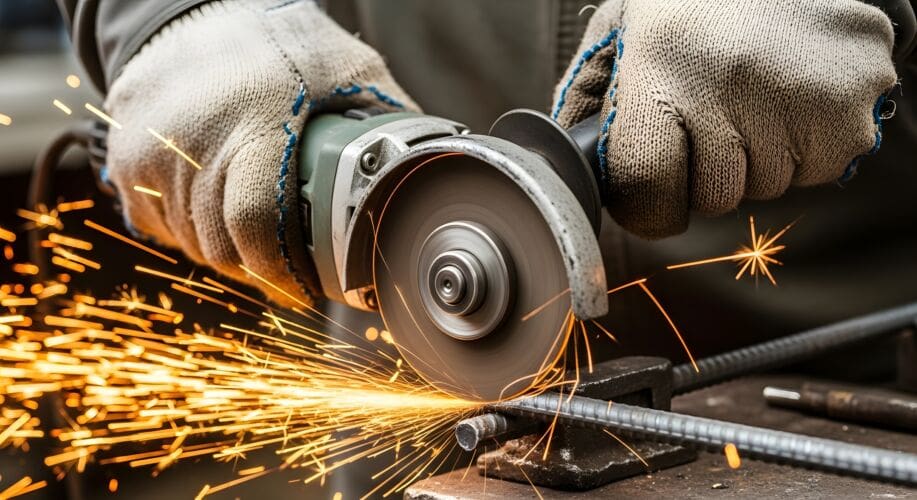
Abrasive wheels are common in UK workplaces – angle grinders in fabrication bays, cut-off tools on site, bench grinders in workshops and tile cutters in fit-out. They are used daily, often without much thought, which is where problems start.
Many serious injuries are caused by simple, repeatable failures. One of the most common is overspeeding. When a wheel is run above its rated speed, the forces involved rise quickly. A fragment breaking away from a wheel operating at around 35 m/s can travel at roughly 85 mph. At that speed, even a small piece of debris can cause serious injury on contact. Other frequent causes include damaged discs, missing guards, poor mounting and loss of control during kickback.
A safety checklist helps catch these issues before the tool is switched on. It gives supervisors, maintenance teams and operators a clear way to check that the wheel is suitable, the tool is set up correctly, guarding is in place and the risks from dust, noise and vibration have been considered. It also makes contractor control clearer and provides straightforward evidence that checks are being done, rather than assumed.
This guide covers the full lifecycle of an abrasive wheel – selection, storage, mounting, speed checks, ring testing, pre-use inspection, safe operation and records – to help your organisation keep workers safe and reduce downtime.
What is an abrasive wheel?
An abrasive wheel is a rotating tool accessory made of abrasive particles bonded together. It removes material through friction and a cutting action.
You might see abrasive wheels in many forms, from thick grinding wheels on bench grinders to thin cutting discs on angle grinders to diamond blades for masonry.
Abrasive wheels generally fall into two broad groups:
- Bonded abrasive wheels – these include resin-bonded and vitrified wheels. They can wear down as you use them and can fail if damaged, incorrectly fitted or run above their maximum rated speed.
- Superabrasive wheels – these include diamond and CBN (cubic boron nitride) wheels, often used for harder materials. Even though they are constructed differently, they still carry hazards from rotating parts, kickback and incorrect mounting.
Different wheels are designed for different forces. A cutting disc is designed for radial cutting force – not side pressure. A grinding wheel is designed to take side load and abrasion. If you swap those functionalities, you increase the chance of breakage and loss of control.
Abrasive wheel safety checklist UK
A checklist only works if people actually use it. It needs to be quick to run through, but comprehensive enough to catch the mistakes that lead to serious injuries.
The most reliable way to do that is to check abrasive wheel safety at clear points in the job: when you select a wheel, when you fit it, before you start the tool and while you are using it.
This checklist is designed for everyday use in sites and workshops across the UK. You can apply it to angle grinders, bench grinders, cut-off saws and similar equipment, and adapt it to match your tools, tasks and site controls.
Before selecting a wheel
- Confirm whether the task is cutting, grinding, fettling or finishing.
- Confirm the material – steel, stainless, masonry, concrete, aluminium or other.
- Select the correct wheel type and grade for the task.
- Check that the wheel diameter matches the tool guard and flange.
- Check that the maximum RPM wheel rating is higher than the tool’s no-load speed.
- Confirm any special restrictions – for example, stainless-only wheels.
Before fitting the wheel
- Inspect the wheel for damage, chips, cracks or moisture.
- Check the expiry date where one applies, especially for resin-bonded discs.
- Confirm the correct flanges, blotters and spacers are used.
- Isolate the tool before changing the wheel by unplugging it or disconnecting the battery.
- Check that the guard is fitted, secure and correctly positioned.
After fitting, before use
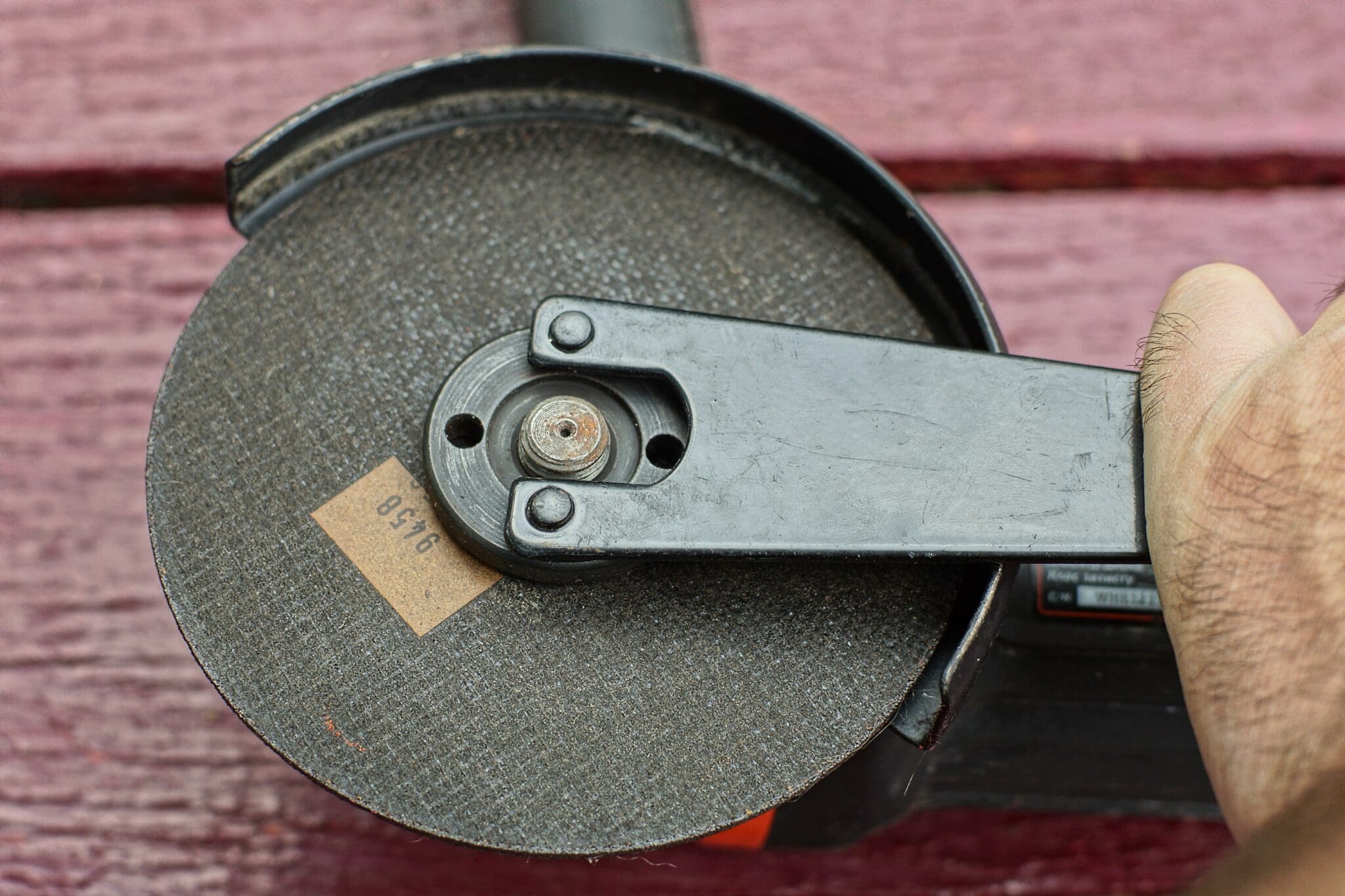
- Tighten the wheel using the correct spanner. Do not use improvised tools.
- For new wheels, carry out a test run in a safe direction for at least 30 seconds.
- Stand to one side during the test run – not in the line of the wheel.
- Check that the tool runs smoothly with no excessive vibration.
During use
- Maintain two-hand control on portable grinders.
- Keep a stable stance and plan for kickback.
- Avoid side loading, especially on cutting discs.
- Do not remove guards or tie them back.
- Stop immediately if you feel unusual vibration, smell burning resin or see wobble.
- Keep sparks away from people and flammable materials.
- Control dust and noise using extraction and appropriate PPE.
After use
- Allow the wheel to stop naturally. Don’t force it against surfaces.
- Store tools safely. Store spare wheels in dry, protected conditions.
- Report defects immediately and remove unsafe wheels from service.
To make this checklist stick, build it into a fixed routine. For example, keep a laminated copy at grinder stations so checks happen at the point of use, and build a quick visual check into supervisor start-of-shift routines.
Where grinding or cutting is higher risk, link it to existing controls rather than creating something new. For example, include it within hot work permits where sparks, fire risk or confined spaces are already managed.
Further guidance: Equipment and machinery – HSE
Abrasive wheel regulations in the UK explained
In the UK, abrasive wheel safety sits under general duties to protect people from risk. In practice, enforcement and investigations often focus on whether you have selected and maintained equipment properly, trained users, controlled exposure risks and prevented dangerous contact with moving parts.
Key legal expectations typically come under:
- Work equipment duties under PUWER, which require equipment to be suitable, maintained and used safely
- Electrical safety duties under the Electricity at Work Regulations, which matter for portable tools, leads and isolation during wheel changing
- Control of hazardous substances and dust exposure, where relevant under COSHH – especially for silica dust from masonry and metal fumes and dust
- Personal protective equipment (PPE) duties under the PPE framework, supported by the HSE’s practical guidance on PPE
There’s no need to focus excessively on regulations and numbers. Instead, focus on the outcomes regulators expect you to achieve that will keep workers safe:
- Correct wheel selection and compatibility with the machine
- Effective guarding and safe access
- Competent users and supervisors
- Safe fitting and inspection routines
- Control of dust, noise and vibration risks
- Clear records that show you manage risks consistently
When something goes wrong, investigators often ask a simple set of questions:
- Was the wheel the correct choice?
- Was it fitted correctly?
- Was the guard fitted?
- Was the user trained?
- Were there signs of damage or misuse?
A strong checklist and training system answers those questions in your favour and, more importantly, prevents the incident in the first place.
Abrasive wheel training requirements UK
If an incident occurs, training is one of the most scrutinised aspects of abrasive wheel safety. That’s because many serious injuries come from routine misuse – wrong wheel type, missing guard, poor mounting, incorrect speed or unsafe body position – that training could have prevented.
In UK workplaces, the core expectation is that anyone who mounts, changes, dresses or uses abrasive wheels is competent. Competence means they can carry out the task safely, using the correct wheel, tool and controls.
Training should cover, at a minimum:
- Wheel types and correct selection for material and task
- Reading markings, including maximum RPM and wheel dimensions
- Pre-use checks and defect recognition
- Safe mounting and the correct use of flanges and blotters
- Guarding requirements and adjustment
- Safe operating techniques and kickback control
- Storage and handling to prevent damage
- PPE and health risk controls for dust, noise and vibration
- What to do if something feels wrong, including stopping and reporting
Decide who needs what level of training, and bear in mind that not everyone needs to mount wheels. Many sites only permit authorised people to handle this task, while others perform pre-use checks and safe operation only. This approach helps keep risk contained, especially where contractors rotate frequently.
Besides being delivered in a classroom environment, well-rounded training should include hands-on practice with real tools and wheels used on site. It should also include periodic refreshers, especially after near misses and updates to tools and equipment.
How to choose the right grinding wheel
Choosing the wrong wheel is a common root cause of incidents. People often pick a disc based on what’s nearby rather than what’s the most appropriate choice. This is risky because wheel design is tightly linked to intended use.
When selecting a wheel, start with these three questions:
- What task am I doing: cut, grind, blend or finish?
- What material am I working on: mild steel, stainless, aluminium, stone, concrete?
- What tool am I using: angle grinder diameter, bench grinder size, cut-off saw?
Then check wheel specifications and compatibility. Focus on:
- Wheel type – cutting disc, grinding disc, flap disc, depressed centre wheel, diamond blade.
- Size – diameter and thickness must match the tool and guard.
- Bore size – must match the spindle and flanges.
- Bond and grade – some wheels suit harder materials, some suit softer. If you use the wrong bond, you can get glazing, overheating or rapid wear.
- Maximum speed – the wheel’s rated speed must exceed the tool’s operating speed.
If you work with stainless steel, choose wheels labelled for this specific use to reduce contamination risk and improve finish quality. If you cut masonry or concrete, choose wheels designed for that task and plan dust controls, because silica risk can be significant.
Also take the environment into consideration. For example, if you work near flammables or in a potentially explosive atmosphere, grinding sparks become a serious hazard. You may need additional controls such as permits, fire watch and spark containment.
Further guidance: The Dangerous Substances and Explosive Atmospheres Regulations 2002 – HSE
Maximum RPM speed check explained
Speed checks are simple, but they are often skipped. Overspeeding can cause wheel failure because centrifugal forces rise rapidly with speed. Even small mismatches matter.
You should always confirm:
- The tool’s no-load speed (RPM) on the nameplate or manual
- The wheel’s maximum operating speed on the wheel label
Then confirm the wheel’s maximum RPM is higher than the tool’s actual RPM. Bear in mind that on busy sites, tools and discs get mixed.
A few practical tips make speed checks easier:
- Standardise grinder sizes by area, so fewer wheel types circulate.
- Store wheels by size and type with clear labels and separators.
- Use colour coding for wheel diameter if your site policy supports it.
- Train supervisors to spot common mismatch patterns, such as small wheels on high-speed grinders.
If a wheel doesn’t show a speed marking or if the marking is unreadable, disregard it and don’t use it. The same applies if the disc is heavily worn and the markings have disappeared.
Speed is also relevant for worn wheels. As wheels wear down, their effective operating speed capability can change depending on design. That is another reason to follow manufacturer guidance and replace wheels in good time.
Ring test procedure for wheels
The ring test is a simple check used mainly for vitrified (ceramic) grinding wheels to detect cracks. It doesn’t apply to all wheel types, and is unsuitable for thin resin cutting discs.
The principle is straightforward: a sound wheel “rings” with a clear tone, while a cracked wheel produces a dull sound.
A practical ring test process is as follows:
- Suspend the wheel on a finger or a non-metallic dowel.
- Tap gently with a non-metallic object such as a wooden mallet handle.
- Tap in several positions around the wheel, not just on the edge.
- Listen for a clear ringing tone versus a dull thud.
- If the sound is dull or uneven, reject the wheel immediately.
Ring testing should be carried out before mounting, especially for wheels that have been stored for long periods, transported between sites or dropped. Damage often occurs during storage, and even a wheel that looks fine may be cracked.
Also remember that ring testing is only one part of inspection. You still need visual checks and correct mounting. If you’re unsure whether a wheel type should be ring tested, check the manufacturer’s instructions.
Pre-use inspection checklist for grinders
Pre-use checks aim to identify faults before the tool is put into service. If a wheel is damaged, incorrectly fitted or unstable in operation, this is where it should be identified.
The checklist below focuses on the checks that need to be completed every time the tool is used, not just after an incident.
Tool condition
- Check that the power cable or battery housing is intact and undamaged.
- Confirm the plug, fuse and PAT status meet site requirements.
- Test the switch to make sure it operates correctly and returns safely.
- Check that the side handle is present and tight.
- Confirm the spindle lock works properly.
- Rotate the tool by hand and listen for loose parts or unusual noise.
Guarding
- Check that the guard is fitted, secure and free from cracks.
- Confirm the guard is positioned to protect the user from the wheel burst direction.
- Make sure the adjustment mechanism works and stays locked in place.
Wheel condition
- Confirm the wheel is the correct type for the task and material.
- Check expiry dates where they apply.
- Inspect for chips, cracks, warping or signs of water damage.
- Confirm the wheel fits the flanges correctly and sits flat.
- Make sure wheel markings are still legible for size and speed.
Function check
- Start the tool in a safe area with the wheel clear of any contact.
- Stand to one side during start-up.
- Watch for wobbling movements, excessive vibration or unusual sounds.
- Stop immediately if anything feels wrong.
These checks need to happen as part of normal tool use, not as a separate exercise. Supervisors should be able to see that checks are being done without asking for paperwork or explanations.
Defect reporting also needs to be quick and straightforward. If it takes effort to report a fault, damaged tools stay in use longer than they should, which is when preventable injuries occur.

Guarding requirements for abrasive wheels
Guarding is a non-negotiable control for most abrasive wheel tasks. Guards reduce exposure to wheel fragments if a wheel fails, and they also reduce the chance of contact with the rotating wheel. Many incidents involve missing or badly adjusted guards, often because a worker moved them to improve access or visibility.
Guards should:
- Cover as much of the wheel as practicable for the task
- Be correctly rated and designed for the tool and wheel size
- Be securely fixed – not loose or improvised
- Be adjusted so they deflect debris away from the user
- Not be removed except where a specific, justified design allows safe use
Portable grinders should also have a side handle, since two-hand control reduces kickback risk and helps the operator keep a stable stance. Bench grinders should have appropriate tool rests, eye shields where fitted, and spark deflectors.
Tool rest clearances need to be kept tight. The gap between the wheel and the tool rest should be adjusted as the wheel wears and kept small enough to prevent workpieces from being pulled in or snagged during use. If the gap becomes excessive, the grinder should be taken out of service until it is reset.
If it appears that a task can’t be completed without the guard being removed, that’s a red flag. Do not remove the guard in any scenario.
Instead, stop and ask:
- Do we have the correct tool for this job?
- Can we use a different wheel type that fits the guard?
- Can we reposition the workpiece?
- Do we need a specialist tool designed for restricted access?
Most of the time, the “need” to remove a guard is actually a planning problem.
Further guidance: Equipment and machinery – HSE
Safe mounting and wheel changing steps
Mounting the wheel incorrectly can cause it to wobble, vibrate or break. It can also increase the chance of the disc coming loose. That is why many workplaces restrict wheel changing to staff who are trained and authorised to do so.
A safe wheel changing method is as follows:
- Isolate the tool – unplug or remove the battery. Don’t rely on the switch.
- Confirm compatibility – check that the wheel diameter, bore, thickness and maximum RPM match the tool.
- Inspect the wheel and flanges – reject damaged wheels. Check that flanges are clean and undamaged.
- Fit correctly – use the correct flanges and any blotters supplied. Fit the wheel the right way round where direction matters. Ensure it sits flat.
- Tighten correctly – use the correct spanner. Tighten firmly, not excessively. Over-tightening can damage the disc or flanges.
- Set the guard – adjust guard position to protect the operator and direct debris away.
- Test run – run the tool in a safe area for at least 30 seconds. Stand to the side. Stop the tool if vibration or wobble occurs.
- Return to work – workers can only start cutting or grinding once the tool demonstrably runs smoothly.
Manage the work area, too. Carry out wheel changes away from active cutting or grinding so the tool and components stay clean and visible. Plan wheel changes into the work routine rather than doing them mid-task, especially on high-pressure shifts, so they are done methodically, following the correct steps.
The difference between cutting discs and grinding discs
Cutting discs and grinding discs are designed for different forces. Mixing them up is one of the most common (and most dangerous) errors – especially with angle grinders.
- Cutting discs – these are thin and designed to cut using the edge. They are not designed for side loading. If you twist, bind or grind with a cutting disc, it can crack and break.
- Grinding discs – these are thicker and designed to take side load. Their functionality is removing material by grinding with the face of the disc.
This difference affects how you use the tool:
- When cutting, keep the disc straight in the cut and avoid twisting.
- When grinding, use the correct angle and let the wheel do the work.
- Never try to finish off a task using the wrong disc just because it’s already fitted.
A good control is to store cutting and grinding discs separately and label stations clearly. Only use discs that fit the guard configuration. If a guard is set up for a thicker disc, a thin cutting disc may leave too much exposure or fit poorly.
Also remember that special usage rules apply to some specialised discs, such as flap discs or fibre discs. If you introduce a new disc type, update team training and pre-use checks.
Abrasive wheel storage and handling rules
Storage is a hidden risk factor, since wheels are very fragile. They can be damaged by moisture, heat, impact or poor stacking. A wheel can look fine but have internal cracks due to being dropped or transported unsafely.
Always follow these storage best practices:
- Store wheels in a dry, clean area away from damp and frost.
- Keep wheels in their original packaging until use.
- Store flat discs flat, supported evenly and not leaning on edges.
- Store larger wheels upright in racks designed for the purpose.
- Keep wheels away from oils, solvents and direct sunlight.
- Do not store wheels on the floor where they can be kicked or run over.
- Rotate stock so older wheels are used first where shelf life applies.
- Do not carry wheels loose in tool bags where they can knock together.
Handling matters as much as storage. Wheels should be treated as fragile components. If a wheel is dropped, it should be taken out of service rather than used “to finish the job”. Rejecting a disc may feel wasteful, but it avoids injuries, damaged equipment and unplanned downtime.
Where tools and consumables move between sites, transport needs comprehensive control measures. Use proper cases or original packaging, and avoid leaving discs loose in vehicles, especially in footwells where they can flex, knock together and heat cycle.
PPE for grinding and cutting work
PPE is important, but it should be used alongside good tool control, guarding and safe technique – not instead of them. PPE should be selected based on the task and the materials involved.
Workers typically need the following PPE:
- Eye protection – impact-rated safety glasses as a minimum. Many tasks also require a face shield.
- Hearing protection – grinding can exceed safe noise levels quickly, so use suitable hearing protection and control noise at source where possible.
- Hand protection – gloves can protect against sharp edges and heat, but you must manage entanglement risk. Loose gloves should not be worn near rotating parts. Always follow task-specific guidance.
- Respiratory protective equipment (RPE) – may be needed when dust is generated, especially masonry dust. Use the right type and ensure face fit where required.
- Foot protection – safety footwear protects feet from dropped tools and workpieces.
- Body protection – close-fitting workwear reduces the risk of snagging. Again, never wear loose sleeves near rotating tools.
Consider mandating that teams should wear face and eye protection together. People sometimes wear a visor but skip glasses underneath. If debris bounces under the visor, eyes are still at risk. A combined approach is often best.
PPE must match the hazard. For example, a simple dust mask may not protect against exposure to fine silica dust.
Dust, noise and vibration controls
Abrasive wheel safety involves preventing long-term harm from daily exposure to dust, noise and vibration. Over time, these factors can cause serious injuries and ill health.
Dust control
Grinding and cutting can generate hazardous dust. Silica dust from concrete, brick and stone is a major health concern. Metal dust can also irritate the lungs and cause health issues.
Dust control should start with the following method:
- Using on-tool extraction where available
- Using water suppression for appropriate tasks, especially masonry cutting
- Using local exhaust ventilation in workshops
- Keeping work areas clean using safe methods, not dry sweeps
- Choosing the right RPE when engineering controls cannot reduce exposure enough
Further guidance: Control of Substances Hazardous to Health (COSHH) – HSE and Construction health risks: Key points – HSE
Noise control
Grinders and cut-off saws can produce high noise levels. Over time, this can lead to hearing loss.
Control noise by:
- Selecting quieter tools where possible
- Maintaining tools to reduce rattle and vibration noise
- Using barriers or distance to reduce exposure
- Planning work to reduce time spent grinding
- Providing suitable hearing protection and enforcing use in high-noise areas
Further guidance: Noise at work – HSE
Vibration control
Hand-held grinders can expose users to hand-arm vibration. High exposure can contribute to HAVS.
Control vibration by:
- Choosing low-vibration tools and well-maintain accessories
- Replacing worn bearings and unbalanced wheels promptly
- Limiting trigger time through task rotation and work planning
- Training users to let the tool do the cutting – there’s no need to force it
- Monitoring exposure where risk is significant
Further guidance: Hand-arm vibration – HSE
When you address dust, noise and vibration together, you also improve quality. Smooth tools, correct discs, and controlled work methods often produce better finishes with less rework.
Common abrasive wheel safety failures
Most abrasive wheel incidents follow familiar patterns. If you recognise the patterns, you can prevent them with simple controls and strong supervision.
Here are the failures that appear repeatedly in investigations, along with the practical fixes.
- Using the wrong disc for the task – people grind with cutting discs or use discs that are not designed for the material.
- Fix: Separate storage, clear labelling and training that focuses on disc function.
- Ignoring maximum RPM – a disc is fitted to a tool that runs faster than the disc rating.
- Fix: Make speed checks part of the safety checklist and remove unlabelled discs from use.
- Missing or defeated guards – guards are removed to improve access or visibility.
- Fix: Stop the job, select the right tool and enforce a rule that guards stay fitted.
- Poor mounting – incorrect flanges, over- or under-tightening, missing blotters or dirty seating surfaces cause instability.
- Fix: Authorise wheel changers, provide the correct tools and follow asset-specific mounting steps.
- Skipping the test run – new discs are used immediately, often with the operator in line with the wheel.
- Fix: Make test runs the default and supervise early in shifts.
- Using damaged or dropped discs – discs that have been poorly stored or carried loose are used anyway.
- Fix: Improve storage and ensure workers know it’s okay to reject a disc.
- One-handed grinder use – control is reduced and kickback risk increases.
- Fix: Require side handles and reinforce two-hand control.
- Poor stance and line of fire – operators stand in the burst line or work in awkward positions.
- Fix: Teach body positioning and build in a simple “where will it go if it kicks?” check.
- Uncontrolled sparks – sparks reach flammables, people or concealed combustible materials.
- Fix: Use spark containment, good housekeeping and hot work controls where required.
- Health risks treated as an afterthought – dust, noise and vibration controls are ignored because the job is seen as quick.
- Fix: Plan controls into the method and make them easy to use.
- Weak records and competence control – after an incident, there is no clear evidence of training, authorisation or inspection.
- Fix: Keep training records, authorisation lists and defect logs simple and accessible.
A useful final check for supervisors is to watch one job from start to finish. Many issues appear within the first minute: missing guard, wrong disc, no side handle, no eye protection, rushed posture. If you correct those early, you can prevent most serious outcomes.

Final thoughts
An abrasive wheel safety checklist is one of the easiest ways to reduce serious risk quickly, because it targets the real causes of injuries: wrong wheel selection, overspeed, poor mounting, missing guards and unsafe operation.
When you combine the checklist with clear training, controlled wheel changing, good storage and strong supervision, you reduce wheel breakage risk, kickback incidents and preventable exposures to dust, noise and vibration.
To make the approach work across shifts and sites, keep it consistent. Standardise wheel types and storage. Make speed checks and test runs normal daily tasks. Treat guarding as non-negotiable. Then back it up with practical records that demonstrate competence and consistency. If you want to benchmark your process against credible UK expectations, the HSE guidance on abrasive wheels and the wider framework under PUWER provide strong external anchors.