In this article
Food temperature control is one of the simplest ways to prevent food poisoning, yet it’s also one of the easiest areas to let slip during busy service. When food sits in the wrong temperature range for too long, bacteria can multiply quickly. Getting this right involves clear targets, routine checks and knowing what to do when something falls out of range.
This article explains the food temperature danger zone in practical terms for UK food settings. It covers chilled storage, hot holding, cooking, reheating and cooling, along with how time and temperature work together. It also looks at how to use probes properly, common mistakes that cause harm and simple records that show checks are being done in real kitchens.
The guidance is based on a HACCP (hazard analysis and critical control points) – the system food businesses use to keep food safe by identifying where risks can arise, setting clear controls at those points, checking them routinely and taking action when they are missed. Our guide aims to make those controls workable in day-to-day service.
Food temperature danger zones explained
You may have heard the phrase “danger zone” to describe the temperature range where bacteria can grow quickly on food. In practice, the danger zone doesn’t apply in the same way to every product. Different bacteria grow at different rates, and food type, acidity, salt, moisture, packaging and oxygen all affect growth.
Despite this, having a broad idea of food temperature danger zones front of mind helps teams make good decisions quickly.
In UK food settings, a common practical rule is that bacteria grow best between about 8°C and 60°C. That is why chilled storage aims to keep food cold, and hot holding aims to keep food hot. You may see slightly different bands in different training materials. What matters is that your controls keep food out of that middle range as much as possible by limiting the time food spends being prepped and transported.
A useful way to explain the danger zone to staff is:
- Cold slows bacterial growth. It does not kill most bacteria.
- Heat can kill bacteria if the food reaches a high enough temperature for long enough.
- Temperatures between chilled and hot holding allow bacteria to multiply quickly.
- Time matters just as much as the number on the thermometer.
So, your daily goal is to keep food either:
- Properly chilled
- Properly hot
- In a controlled process that moves it safely from one state to the other
In a working kitchen, it’s normal for food to pass through the danger zone during normal operations. For example, a cooked sauce cools, a delivery warms slightly in a corridor, or a tray of chicken rests before service. You control risk by limiting how long food spends in that range and by using safe methods for cooking, cooling and reheating.
For simplicity and consistency, many businesses set clear internal targets such as:
- Fridges at 5°C or below, with a preference for 0–5°C
- Freezers at –18°C or below
- Hot holding at 63°C or above
- Reheating to at least 75°C (or an equivalent time-temperature combination) before hot holding
At what temperature do bacteria grow fastest?
Many food poisoning bacteria multiply fastest at temperatures close to body temperature. That’s why food left warm, rather than properly chilled or properly hot, quickly becomes high-risk. Some bacteria can still grow at lower temperatures, which is why chilled storage needs to be reliable.
Focus on what this means in real life:
- A warm kitchen can speed up bacteria growth on prepared food.
- Large pots cool slowly and stay in the high-growth range for longer.
- Shallow trays cool faster, which reduces the time in the high-risk range.
- Hot holding that drops below the minimum temperature allows bacteria to multiply and increases risk.
It also helps to remember that bacteria need the right conditions to thrive. They grow faster in foods that are moist, protein-rich and near neutral pH. That includes many of the foods you handle every day: cooked meats, poultry, rice, pasta, dairy, soups, sauces, gravies and stews.
Some bacteria, such as Listeria, can grow at fridge temperatures. That is why chilled storage needs to be reliable, and why “use by” dates matter.
Safe fridge temperature for food in the UK
Just because a fridge is cold doesn’t mean it’s automatically safe. It’s only safe when it holds food at a temperature that slows bacterial growth reliably, across the whole cabinet, even when the door opens often. That is why you need a target and a habit of checking it.
Many UK businesses aim for a fridge temperature of 5°C or below. Some set 4°C as an internal target to provide a buffer, because fridges cycle and there are often warmer spots near doors and top shelves. Rather than chasing a perfect reading, aim to keep all chilled food in the safe range and respond quickly if a unit fails.
Practical fridge control checks include:
- Check and record fridge temperatures at least daily, and more often in higher-risk settings.
- Use an independent thermometer, not only the built-in display.
- Keep airflow clear by avoiding over-stacking and blocking fans.
- Store raw meat and poultry below ready-to-eat food to prevent drips and cross-contamination.
- Keep lids on foods and label prep dates clearly.
- Plan deliveries so chilled food goes straight into cold storage.
- Pre-portion food before peak periods.
If a fridge is running warm, take immediate action:
- Move high-risk foods to another fridge that is within target.
- Check whether the door seals, air vents or drainage channels are causing the problem.
- Call maintenance early and record the action taken.
Hot holding temperature requirements in the UK
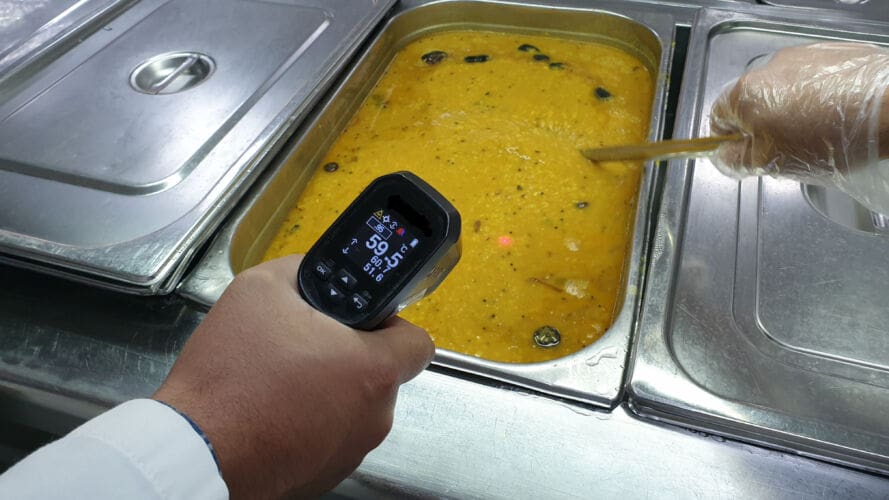
During hot holding, food temperature can easily drift into the danger zone. Even if it looks hot, the food may be cooling in the centre. Bain-maries, hot lamps and heated displays can also create uneven heat distribution. A tray surface may stay warm, while the middle drops below target. For these reasons, hot holding needs a clear minimum temperature and routine probing.
In the UK, a common hot holding target is 63°C or above. Many businesses treat 63°C as the minimum and aim a little higher for a buffer, especially during service.
Avoid treating hot holding as a storage method. It’s a temporary stage. The longer food sits, the more likely quality drops and temperatures drift. Use hot holding to bridge the gap between cooking and serving.
Here are some strong hot holding controls:
- Preheat hot holding equipment before loading food.
- Only put hot food into hot holding, never warm food.
- Stir sauces and liquids regularly to distribute heat.
- Keep lids on where you can to retain heat and reduce drying.
- Avoid overfilling units, as this can reduce heat circulation.
- Probe the thickest part of the food, not the food at the tray edge.
If food falls below your hot holding minimum temperature, it’s time to stop and decide what happens next. Reheat it once only, if your process allows and you can confirm it has been under control. If you cannot confirm safe control, discard it. Set clear rules before busy service periods to keep everyone on the same page.
Cooking temperatures for common foods
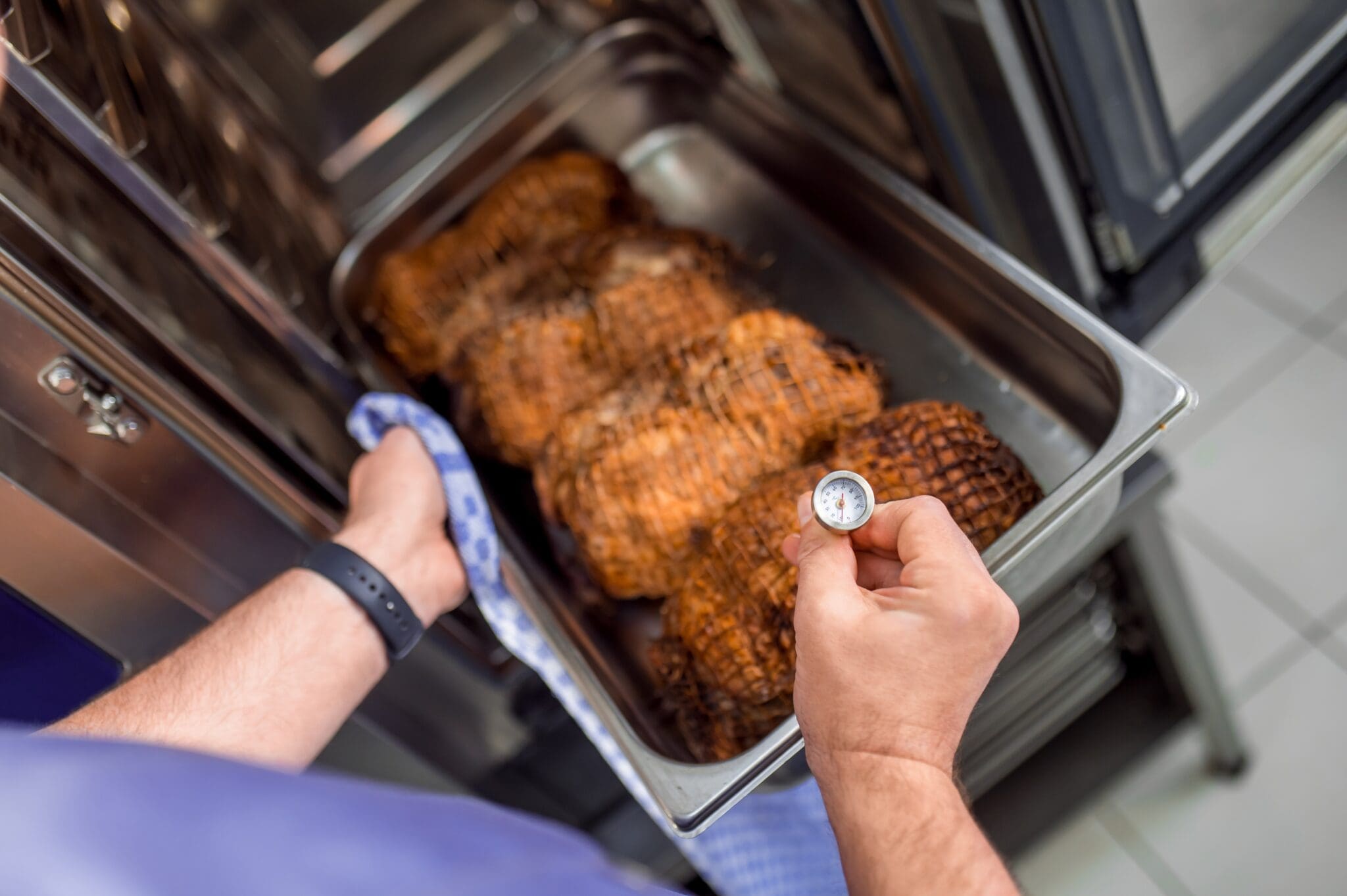
Cooking reduces harmful bacteria when the food reaches a sufficient temperature throughout. That means the thickest part of the food needs to reach the target temperature, not just the surface.
Different foods and processes use different validated time-temperature combinations. Many UK kitchens use a simple rule: cook to at least 75°C at the core. Some processes use alternatives, such as 70°C for two minutes. What matters is that your method is consistent, evidence-based and suitable for your menu.
Here are practical core targets many businesses use as internal standards:
- Poultry and stuffed meats: 75°C or above
- Minced meat products (burgers, sausages): 75°C or above, unless you have a validated alternative
- Whole cuts of beef or lamb: target based on menu and risk, with careful control for rare service
- Reheated cooked foods: 75°C or above
- Sauces, soups and gravies – bring to a rolling boil, then confirm core temperature where practical
Because menus vary, it makes sense to set clear cooking rules for the foods that carry the highest risk. For each of these items, staff should know what “done” looks like in practice, including the target temperature, how long it needs to cook and when a probe check is required. This keeps decisions consistent and avoids guesswork during service.
Probe checks matter most when:
- The product is thick or uneven, like a large joint or layered dish.
- You batch cook and cool for later service.
- You cook poultry, minced meats or mixed dishes like curries.
- You use microwaves, which can heat food unevenly.
A simple cooking temperature routine can look like this:
- Check the probe is clean and calibrated.
- Insert into the thickest part, avoiding bone.
- Wait for the reading to stabilise.
- Record the result for the batch, not every single item.
- If the temperature is below target, continue cooking and check it again.
Reheating temperature rules in the UK
Reheating is a higher-risk step because it often happens under time pressure. Food is sometimes reheated until it feels hot enough to serve – not hot enough to be safe. Thick portions, sauces and microwaved dishes can be hot on the outside while the temperature at the centre remains in the danger zone.
A practical reheating rule used widely in UK catering is to reheat food to at least 75°C at the core, then hot hold at 63°C or above and serve promptly. Reheating should be quick, because slow reheating keeps food in the growth range for longer. If equipment cannot bring food up to temperature fast enough, the process needs adjusting – for example, by reheating smaller portions, using shallow pans or changing equipment.
Good reheating practice includes:
- Reheating food once only and avoiding repeated cool–reheat cycles
- Reheating from chilled, not from room temperature
- Reheating quickly to minimise time in the danger zone
- Stirring food during reheating to remove cold spots
- Covering food in microwaves where appropriate to improve heat distribution
- Probing the thickest part of the food and taking more than one reading if it heats unevenly
If you are reheating food for vulnerable groups, such as in care settings, controls need to be tighter. Older adults, young children and people with weakened immune systems are more likely to become seriously ill from food poisoning. In these settings, reheating should consistently reach the full core temperature target, temperature checks should be routine rather than occasional, and food should be served promptly after reheating rather than held for extended periods.
Cooling food quickly – the two-hour rule
Cooling is where even the most diligent kitchens sometimes slip. Cooking kills bacteria – but once the food’s temperature reaches the danger zone, any surviving bacteria can multiply. Some bacteria can also form spores that survive cooking and then grow during slow cooling. That is why cooling needs to be carried out with speed and structure.
Many kitchens use a simple “two-hour rule” as a practical target: cool food quickly, aiming to get it out of the danger zone as fast as possible. You may see different time targets in different systems – but what matters is that your method achieves rapid cooling reliably and that you can demonstrate control.
Cooling is safest when heat can escape quickly. Enable this by increasing surface area and reducing depth, so food moves through the danger zone faster.
Practical cooling methods include:
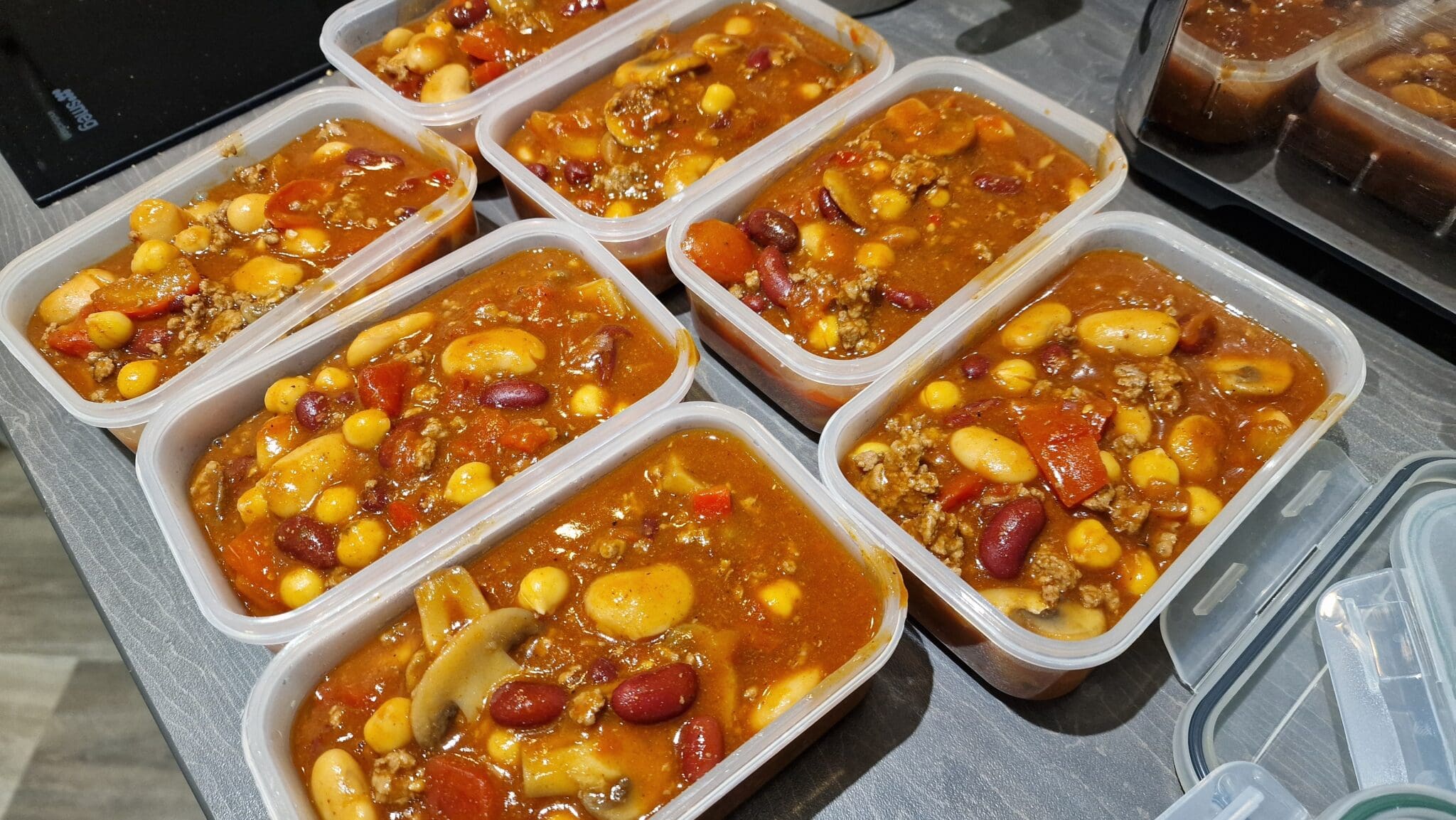
- Dividing large batches into smaller, shallow trays
- Using blast chillers where available and following loading guidance
- Stirring liquids such as soups and sauces to release heat
- Using ice baths for containers, with care to avoid water contamination
- Using cooling wands or paddles for thick sauces
- Leaving lids off initially to release steam, then covering once chilled to prevent contamination
Do not place large, hot pots straight into a fridge. The food will cool slowly and raise the fridge temperature, putting other chilled food at risk. Cool food quickly using safe methods first, then transfer it to chilled storage.
To make cooling easy to manage, set clear rules for your team:
- Start cooling immediately after cooking, not after the service rush.
- Label the tray with the time the cooling started.
- Check and record the temperature at set points if your HACCP plan requires it.
- Transfer to the fridge once the food is cool enough and covered.
How to check food temperatures with probes
It’s important to use a temperature probe effectively. Many “bad readings” come from poor technique: measuring the temperature at the surface, hitting the tray or not waiting for the reading to settle. Food probing also needs good hygiene, because a contaminated probe can spread bacteria from raw to ready-to-eat food.
Here’s a practical probe method for kitchens:
- Clean the probe before use – use alcohol wipes or hot soapy water and dry it. Keep wipes near service points.
- Check calibration – use an ice point check if your system requires it. Record the check.
- Insert correctly – push the tip into the thickest part of the food. Avoid touching bone, tray edges or the container.
- Wait for stability – hold the probe steady until the temperature stops moving.
- Take a second reading if needed – for thick or uneven dishes, check another point.
- Record what matters – record the batch, the temperature, the time and the initials of the checker. Record any corrective action.
- Clean again – clean the probe after use and store it safely.
Treat the probe like a knife, cleaning it before and after every use. If you probe raw meat, clean the probe again before probing cooked food.
Also, choose the right probe type for your operations. A thin tip works well for thin products. A robust probe suits thick foods. Infrared thermometers can be useful for surface checks, but they shouldn’t replace core probing for high-risk foods.
Temperature record sheet template
Records need to be consistent, clear and linked to action. Inspectors typically look for two things: that you monitor the controls that matter, and that you act when things go wrong. A neat sheet full of perfect numbers with no corrective actions can look suspicious, because real kitchens have variation.
A usable temperature record sheet template can include:
- Date
- Unit or location (fridge 1, freezer 2, hot holding bain-marie, delivery van)
- Target range (for example, 0–5°C for chilled storage)
- Actual temperature reading
- Product or batch reference where relevant
- Check time
- Name or initials
- Corrective action taken if the temperature is out of range
- Supervisor sign-off for repeated issues
Here is a simple format you can copy:
- Date:
- Area/equipment:
- Target:
- Reading:
- Time:
- Checked by:
- Action if out of range:
- Follow-up check result:
- Notes:
To make records even stronger, add a simple trend column such as “OK”, “monitor”, “action”. This helps staff decide immediately whether they can carry on, need to keep an eye on the situation, or must take corrective action. It also helps managers spot patterns during weekly reviews.
Digital systems can be useful, especially for multi-site businesses. Yet paper is still a good option if it’s used well. The best system is the one people actually complete during service.
How long can food sit out?
This is one of the most common questions in kitchens and care settings.
The length of time food can sit out depends on the food, the temperature of the environment and whether the food is high-risk. That said, you can still set clear, safe rules for typical UK service.
Risk is introduced when food sits in the danger zone for too long. In practice, you control risk by:
- Keeping cold food cold until service.
- Keeping hot food hot until service.
- Limiting time at room temperature during prep and plating.
- Using time limits for items that must sit out, such as during buffet service.
For many businesses, these are helpful rules to follow:
- High-risk chilled food should not sit out at room temperature for longer than necessary. Aim to keep it under two hours total across prep and service, and less in warm conditions.
- Hot food should move quickly from cooking to serving or hot holding.
- If food has sat out and you cannot confirm safe control, discard it.
You can also build practical time stamps into your workflow:
- Label trays with an “out of fridge” time.
- Use colour tags for buffet items with start times.
- Replenish food in small batches so that it doesn’t sit for long.
Remember that room temperature in a busy kitchen can be higher than you think. Summer service, ovens, dishwashers and tight spaces can raise ambient temperature and speed up bacterial growth.
Buffet and catering temperature controls
Buffets and catering services are challenging because food sits out by design. Buffet safety is about controlling the temperature and avoiding contamination.
For hot buffets, your controls should focus on:
- Keeping food hot at 63°C or above in the service equipment
- Preheating bain-maries and hot plates before loading
- Using shallow pans and stirring regularly for even heat
- Replacing food in smaller batches rather than topping up old food
- Keeping lids on where possible and using sneeze guards
For cold buffets, your controls should focus on:
- Keeping food chilled at 8°C or below, with a preference for 5°C or below if you can
- Using refrigerated display units or ice beds that actually maintain temperature
- Serving in small batches and replenishing often from a fridge
- Keeping high-risk foods covered and protected from hands and droplets
- Removing items that warm up and replacing them with chilled stock
For off-site catering, add transport controls:
- Using insulated containers and chilled transport where needed
- Keeping hot food hot and cold food cold during travel
- Minimising loading time with a clear plan and staged packing
- Probing and recording temperatures on arrival and during service
Here’s a practical buffet checklist you can use:
- Equipment preheated or pre-chilled before loading
- Temperatures checked at set intervals during service
- Small-batch replenishment in place
- Separate utensils for each dish and replaced if dropped
- Clear allergen labels and separate serving areas where needed
- Clear discard rules after service
Common temperature control mistakes
Most temperature mistakes occur due to ordinary everyday workflow issues – not significant one-off failures. Food is left out for longer than planned, fridges are packed too tightly, hot holding is started too early, or temperature checks are skipped when service gets busy. Improving these key practices often reduces risk quickly, without new equipment or major expenses.
Here are some common mistakes to watch for:
- Relying on “feel” instead of checking food temperature with a probe
- Putting warm food into a fridge and warming the whole cabinet
- Cooling large batches in deep containers
- Holding hot food at too low a temperature because equipment is not preheated
- Topping up buffet trays instead of replacing them
- Reheating food slowly, especially in bain-maries
- Reheating food more than once
- Not checking deliveries promptly and accepting chilled goods that are actually warm
- Keeping fridges too full and blocking airflow
- Failing to act when temperatures are out of range
Temperature control best practices should be part of the workplace routine and culture. It helps to turn these into training points and quick audits. For example, a supervisor can do a five-minute temperature walk once per shift.
Food temperature legal requirements in the UK
UK food law doesn’t require businesses to keep specific foods at specific temperatures. It simply sets out a duty to keep food safe.
Temperature control is one of the main ways you can meet that duty, and inspectors expect you to have a system that works on the ground.
In England, Wales and Northern Ireland, the main framework comes from retained EU food hygiene rules and UK regulations that require businesses to implement procedures based on HACCP principles. Scotland uses a similar approach.
Inspectors look for:
- A documented food safety management system
- Clear control measures for high-risk steps, including temperature
- Monitoring records that are real and consistent
- Corrective actions when issues occur
- Training and supervision that matches your risk
- Evidence that you review and make improvements
Temperature rules also show up in specific contexts, such as chilled food storage, hot holding and safe cooking. Yet the key point for businesses is due diligence. If you can show you identified your hazards, set sensible controls, trained staff, monitored performance and acted on problems, you are in a far stronger position if something goes wrong.
This is also why record keeping matters, proving you ran your system properly when it counted.
How temperature controls fit into HACCP
In a HACCP-based system, temperature limits are fixed decision points. They define when food is under control and when action is required.
The aim is to keep the number of critical limits small and clear. Staff should not be deciding targets on the fly or debating whether something is “probably fine”. A reading is either within the safe limit, or it triggers a defined response.
This is where records matter. They show that limits were set in advance, checks were carried out, and action was taken consistently when something went out of range. That is what inspectors look for when assessing due diligence.
Final thoughts and further reading
The food temperature danger zone matters because it’s where bacteria can multiply quickly and quietly. You cannot see it, and you often cannot smell it, yet it can still cause illness, complaints and enforcement problems. The solution is not complicated. Keep food cold enough, keep hot food hot enough, and move food through the middle temperatures quickly and in a controlled way.
Set clear targets that staff can remember. Check fridges, freezers and hot holding routinely. Cook high-risk foods to a safe core temperature, and reheat quickly to a safe core temperature before holding or serving. Cool cooked food fast in shallow containers and avoid loading hot food into fridges. Use probes properly and clean them every time. Keep records that show real checks and real corrective actions. Finally, tie the whole approach into a simple HACCP-based system so everyone knows what to do and why.
If you want to check your approach against recognised UK guidance, these resources are a good place to start.
- Food Standards Agency
- Temperature control guidance – clear explanations of chilled storage, hot holding, cooking and reheating expectations used by inspectors.
- Food hygiene ratings scheme – explains what inspectors look for during inspections, including temperature control, records and due diligence.
- Safer food, better business (SFBB) – a simple, HACCP-based food safety management system used widely across UK catering, retail and care settings. Includes temperature controls, records and corrective actions.
- NHS
- NHS advice on food poisoning – useful background on symptoms, high-risk foods and why temperature control matters, especially for vulnerable people.
- National standards for healthcare food and drink – detailed standards for food safety, nutrition and service in healthcare settings, including vulnerable groups where temperature control is especially important.
- Chartered Institute of Environmental Health (CIEH) – the professional body for environmental health officers. Its guidance reflects how inspections are carried out in practice and what officers look for around temperature control, records and due diligence.
- Health and Safety Executive – while food safety sits mainly with the FSA, HSE guidance is useful for workplace controls that affect food safety, such as equipment use, refrigeration maintenance, and temperature monitoring systems in larger operations.