In this article
Why manual handling matters in healthcare
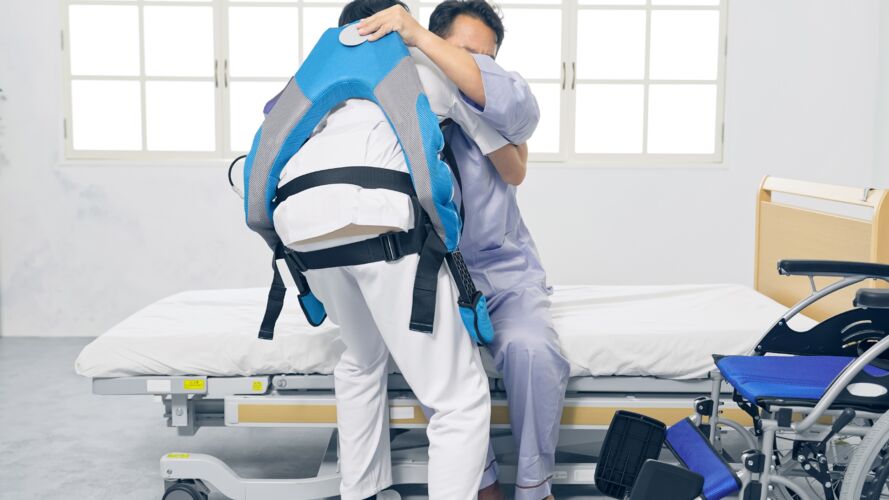
Manual handling is part of everyday life in hospitals, clinics and community settings. From helping a patient from bed to chair, to repositioning someone in a wheelchair, to moving vital equipment, healthcare professionals carry out countless handling tasks during each shift.
These actions may feel routine, but they can cause musculoskeletal injury if done incorrectly. The Health and Safety Executive (HSE) reports that manual handling contributes to a significant proportion of work-related musculoskeletal disorders in the healthcare sector, leading to pain, reduced mobility and long-term absence from work.
Ensuring that every staff member understands safe manual handling underpins patient and staff safety, quality of care and the smooth operation of services across the NHS and private care sector.
Protecting both staff and patients
Good manual handling techniques benefit everyone. They help staff avoid back pain, strains and repetitive injuries, while also protecting patients from falls, skin damage and discomfort.
Just one injury can create staffing shortages and compromise care, putting pressure on the whole team. That’s why investing in safe handling training and resources builds resilience, protects staff and keeps services running reliably.
Common risks and injury types
Healthcare workers face a range of physical hazards each time they lift, push, pull or support a load.
The most common injuries come from:
- Using too much force
- Working in awkward positions
- Repeating the same movements frequently
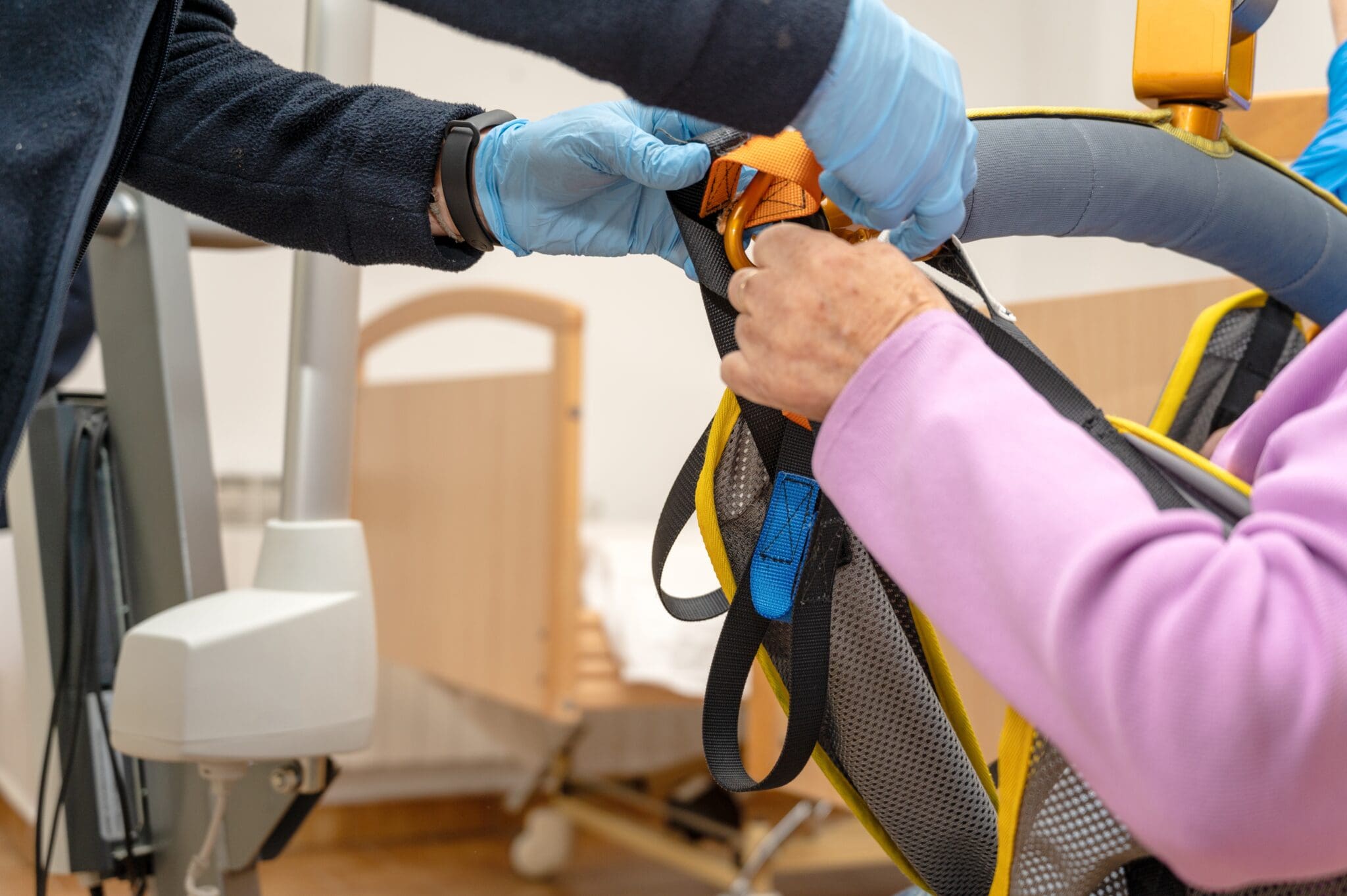
For example, staff may develop lower back pain after bending to help a patient, shoulder strains from lifting mattresses, or wrist and hand conditions from manipulating hoist slings without the right grip.
Musculoskeletal disorders often present as chronic ache, numbness or muscle stiffness. Left unaddressed, these symptoms can progress to herniated discs or nerve compression syndromes.
Acute injuries can also occur. For example, a healthcare worker might tear a muscle or sprain a ligament when supporting a patient who is unexpectedly heavy or unsteady.
Even small mistakes in technique can add up over time. Twisting while lifting or bending at the waist instead of the knees amplifies spinal compression and raises the risk of injury.
The impact is not just physical. Injured staff face:
- Stress
- Anxiety about returning to work after an injury
- Loss of confidence in their ability to provide safe care and maintain patient trust
Meanwhile, patients may feel unsafe or uncomfortable during handling, eroding trust in the healthcare team.
Recognising the multifaceted risks in everyday manual handling tasks is the first step towards a prevention-focused culture.
UK legal requirements and HSE guidance
Under UK law, employers have a clear duty to protect workers from manual handling risks. Here’s a look at the key regulations.
The Manual Handling Operations Regulations 1992
The main legislation is the Manual Handling Operations Regulations 1992. These regulations require a risk-based approach to any task involving lifting, lowering, pushing, pulling, carrying or moving.
The regulations stipulate that employers must:
- Avoid manual handling tasks that involve a risk of injury, so far as is reasonably practicable.
- Assess the risk of injury from any unavoidable manual handling tasks.
- Reduce the risk of injury through mechanical aids, redesigning the task or changing work practices.
A thorough risk assessment looks at key factors like the weight of the load, the frequency and duration of handling, the posture required and the individual’s capability.
Assessments must consider environmental aspects. Slippery floors, cramped spaces and poor lighting all increase risk.
Once they have identified risks, the employer must put control measures in place. In many healthcare settings, it’s not possible to eliminate manual handling entirely – patients often require hands-on support. In these cases, the emphasis shifts to using hoists, slings and slide sheets, redesigning patient rooms to improve access and ensuring teams work together to share loads.
It’s important to note that the Manual Handling Operations Regulations 1992 should inform a continuous cycle of evaluation, control and review. Organisations shouldn’t think about them once and forget to follow up. This approach will be key to maintaining a safe clinical environment.
HSE guidance
The HSE gives detailed guidance on safe handling methods and organisational controls – things like workplace layout, equipment provision and staff training.
Healthcare organisations are encouraged to follow HSE’s practical advice on moving patients and loads safely, ensuring their policies are consistent with national standards. For instance, the HSE’s Manual Handling in the Health Service guidance outlines best practices for patient handling, emphasising the hierarchy of controls – from cutting out unnecessary handling to providing mechanical aids.
RIDDOR 2013
The Reporting of Injuries, Diseases and Dangerous Occurrences Regulations (RIDDOR) 2013 mandate that serious injuries, including those caused by manual handling accidents, are reported to the HSE.
Patient handling vs object handling: Key differences
Healthcare manual handling falls into two broad categories: patient handling and object handling. While both involve moving loads, each has its own challenges and calls for tailored strategies.
Recognising the differences is key to choosing the right controls. While generic training can cover the basics of lifting objects, patient handling requires scenario-based training, clinical judgement and confidence in using transfer devices.
Object handling
Object handling typically involves inanimate loads such as equipment trolleys, oxygen cylinders and supply boxes.
Risks arise from weight, bulk, uneven surfaces or unbalanced loads. Standard safe lifting techniques (bending the knees, keeping the back straight, holding loads close to the body) often suffice, supplemented by trolleys, lifters or conveyor systems for heavier items.
Patient handling
Patient handling involves multi-dimensional risks. Patients can’t be gripped like boxes; they move unpredictably and have limited ability to assist. They can also feel and express discomfort.
As a result, caregivers should communicate effectively, continually assess the patient’s condition and adapt techniques as they go.
Using specialised equipment is essential (e.g., mobile hoists, standing aids, turning mattresses and slide sheets). Staff must establish trust with the patient and explain each step of the process. They should also get the patient’s consent before proceeding. This helps ensure patient dignity and comfort.

Risk assessment and task planning
A robust risk assessment underpins every safe manual handling activity. Before touching a load – whether it’s a patient or an equipment trolley – staff should pause to plan the task.
Task planning minimises surprises. It also makes sure that everyone is on the same page before starting and that necessary aids and protective clothing (e.g., non-slip footwear, gloves) are on hand before the first lift.
Key considerations include:
- Load characteristics – weight, shape, stability and whether the patient can assist
- Environment – floor surface, available space, obstacles and lighting
- Individual capability – staff member’s strength, training level, fatigue and any health considerations
- Equipment availability – hoists, slide sheets, adjustable beds or trolleys
- Team resources – number of staff present, clear roles and communication channels
Best practice involves a five-stage assessment: stop and think, notice hazards, evaluate risks, prevent or reduce risks, and review controls after the task.
Documenting assessments for complex moves – such as a two-person lateral transfer – ensures accountability and provides a reference for future training.
The principles of safe manual handling
Safe manual handling is built on the following principles:
- Plan – analyse the task, identify risks and select appropriate controls.
- Prepare – position equipment within easy reach, adjust bed or trolley heights and clear pathways of clutter.
- Perform – execute moves using good posture (bend at the knees, maintain a neutral spine, avoid twisting) and keep loads close to the centre of gravity. When handling patients, seek consent, explain each step and encourage active participation where possible.
- Review – once the task is complete, debrief with the team. Note any difficulties or hazards you came across and suggest improvements for next time.
It also helps to keep a wide, stable base with your feet, use your leg muscles for power and keep elbows and shoulders in line. Supportive tools like slide sheets with ergonomic handles or hoist slings with colour-coded loops make good technique easier to follow.
Posture, lifting techniques and body mechanics
Optimal body mechanics reduce strain and evenly distribute forces through the musculoskeletal system.
When lifting or supporting a load:
- Keep the back straight and avoid bending at the waist. Maintain the spine’s natural curves to minimise disc pressure.
- Bend at the hips and knees, engaging the powerful muscles of the thighs and glutes rather than relying on the lower back.
- Hold loads close to the body; every 10 cm increase in distance from the midline doubles the force on the spine.
- Move smoothly, avoiding jerky or sudden movements that can overload tissues.
- Turn with the feet, not by twisting the torso. If a patient or load needs to be moved in another direction, reposition your feet and take small steps.
Other tips include:
- Regularly alternating tasks – switching from standing to seated transfers, for example – to distribute muscle load and reduce fatigue
- Incorporating micro-breaks for gentle stretches, easing stiffness during long shifts
- Wearing proper footwear with supportive soles and non-slip treads
Using hoists, slings and transfer aids safely
Mechanical aids transform manual handling by taking the pressure off carers. Ceiling-mounted hoists, mobile hoists and standing aids, when used correctly, remove most of the physical strain. However, not using this equipment correctly or safely can cause dropped loads or pinching injuries.
Before every lift:
- Inspect the hoist and slings for wear, damage or loose components.
- Check that the sling type matches the patient’s weight and condition (e.g., full-body sling for immobile patients, divided-leg sling for toileting).
- Position the sling correctly under the patient, ensuring the fabric isn’t bunched and all straps are accessible.
- Test the system with a gentle lift to confirm the patient is comfortable and stable before proceeding.
- Communicate clearly with the patient, describing what will happen. Encourage them to tell you if they feel discomfort.
Training should cover how to carry out emergency lowering and how to manage batteries for powered hoists.
Staff also need clear instruction on using transfer aids such as slide sheets, low-friction mats and transfer boards. Knowing correct placement and ergonomic handling protects patients and staff from shear injuries.
Handling bariatric patients: Extra precautions
Caring for bariatric patients introduces additional challenges due to increased weight and potential mobility limitations. Standard equipment may not always be suitable for higher weight capacities, and rooms often need to be arranged to provide enough space for larger hoists and slings.
Key strategies include:
- Specialist equipment – bariatric hoists rated for higher loads, wider beds with reinforced frames and heavy-duty sliding aids
- Team coordination – establishing clear roles, with at least two trained staff per transfer, plus lifting belts or handles designed for bariatric support
- Environmental considerations – widening doorways, reinforced flooring to bear higher loads and enough turning space for mobile hoists
Pre-transfer assessment – checking equipment weight limits, confirming patient consent and making sure that any wounds or pressure areas are protected
Organisations should keep an up-to-date inventory of bariatric aids, carry out regular checks and train staff on how to use them.
Early risk assessment ensures these resources are available where and when they’re needed, preventing last-minute improvisation that can jeopardise safety.
Team lifting and communication protocols
Many manual handling tasks require whole team participation, which depends on synchronised actions, good teamwork and clear communication.
Before lifting:
- Brief the team on the plan, roles and count-in signals (e.g., “On three: one, two, three, lift”).
- Agree on who will lead the move and how to respond if the patient expresses discomfort or if a hazard arises.
- Position team members evenly around the load to distribute weight and stay balanced.
During the lift, a designated leader gives the signals to start, pause or lower. Everyone should keep line-of-sight where possible, and in noisy areas use non-verbal cues such as eye contact or hand signals.
Following the lift, a quick debrief can highlight any communication breakdowns or coordination issues. The team can feed these insights back into future training and task planning.
Training requirements for healthcare staff
Comprehensive manual handling training is a legal and clinical requirement.
The Manual Handling Operations Regulations 1992 mandate that all staff who undertake handling tasks are trained on risk assessment, safe techniques and how to use aids. Refresher training should take place at least every two years or sooner if any issues emerge.
NHS Employers offers sector-specific training modules that combine theory with hands-on practice. These cover patient transfers, correct posture and hoist operation. Simulation suites and peer review sessions also give staff the chance to build confidence in realistic scenarios before working on wards.
Training records must be kept up to date to reflect attendance, the competencies assessed and any additional support required.
Beyond initial induction, bespoke programmes for specialist areas – maternity, critical care or community nursing – ensure that techniques are tailored to specific patient groups and settings. For example, maternity teams may practise supporting women in labour, while community nurses may focus on moving patients safely in home environments.
Reporting incidents and early injury signs
Spotting the early signs of discomfort or injury is key to stopping long-term problems from developing. Organisations should make it easy for staff to speak up about near misses, aches or strains without worrying about stigma.
Incident reporting systems – ideally built into electronic health records or staff portals – should note what the task involved, what risks were spotted and any quick fixes made at the time.
The first signs of musculoskeletal stress often include persistent soreness, reduced range of motion or tingling sensations. These symptoms should trigger a referral to occupational health and, if necessary, a temporary change of duties.
Looking back at reported incidents can reveal systemic issues – equipment shortages, high patient acuity or understaffing – and guide interventions to reduce recurrence. Acting on these insights reduces the chance of problems happening again. Just as importantly, giving staff clear feedback shows their concerns lead to real improvements, which helps build a culture of continuous safety.
Supporting a safety culture in clinical environments
Safe manual handling thrives in workplaces where safety is valued as much as clinical outcomes.
Leaders play a key role by taking part in training and celebrating team achievements in safe handling. Crucially, they are responsible for allocating budget for up-to-date equipment, helping staff do their jobs safely and effectively.
Some healthcare organisations use regular ward-based safety huddles as a helpful way to provide a forum to discuss recent handling challenges and share learning. Multidisciplinary involvement – including physiotherapists, occupational therapists and health and safety officers – ensures a holistic approach.
Manual handling in community and domiciliary care
Community and domiciliary settings bring unique manual handling challenges.
Carers often work alone in unfamiliar home environments, dealing with uneven floors and often limited space. In these settings, they may not have mechanical aids to help them. Effective risk management starts before the visit, with phone or video assessments to identify hazards and arrange for equipment, if needed, to be delivered. Travel-sized slings, portable hoists and lightweight slide sheets make helpful additions to the carer’s on-the-go toolkit.
Training for community staff focuses on safe lone-working strategies. These include carrying personal alarms, scheduling visits during daylight hours and keeping open communication with base teams.
Partnerships with local NHS services or occupational therapy teams can also make a difference. They provide quick access to equipment and expert advice, helping to close the gap between hospital care and care at home.
Ergonomic considerations and equipment maintenance
Even the best handling techniques can falter if equipment is poorly maintained. Hoists with flat batteries, worn-out slings or sticky castors are just some examples that undermine safety.
Routine equipment checks – daily visual inspections by users and periodic servicing by biomedical engineers – prevent failures. Maintenance logs must be readily available, documenting repairs, replacement parts and calibration tests.
Ergonomics also plays a part in safety. Thoughtful ergonomic design minimises the need for excessive reaching or bending, complementing staff training in safe techniques.
For example, adjustable bed and trolley heights, along with clear floor markings, guide optimal positioning. Anti-fatigue mats in areas where staff stand for long periods can ease strain on the legs and back.
Refresher training and policy updates
Manual handling guidance is always evolving to keep up with new evidence, equipment innovations and regulatory changes. Healthcare practices should review policies annually or whenever the HSE updates its recommendations. By maintaining an active, responsive approach to policy and training, organisations ensure that safe manual handling remains integral to high-quality, compassionate healthcare delivery.
Policy updates and new industry challenges or innovations prompt refresher training sessions. These refresh core skills and introduce any new protocols – such as updated safe patient handling algorithms or digital training platforms. Embedding short practical sessions into team meetings keeps knowledge current and reinforces peer-to-peer learning.
Organisations should communicate updates clearly through staff bulletins and the intranet. They can also be notified using visual prompts around handling equipment. Regular audits then check whether procedures are being followed, using measures such as incident rates, training completion and equipment fault reports.