
In this article
Anxiety can feel like your mind has hit a steep slope. Thoughts speed up, your body reacts, and suddenly you are caught in a loop of ‘what if’ scenarios, physical sensations and fear about the fear itself. In those moments, advice like “just think positive” often feels dismissive and unhelpful. It can even make you feel more alone, because you are already trying to cope.
Grounding is different. Grounding techniques are practical ways to bring your attention back to the here and now, so your nervous system gets the message that you are safe, at least in this moment. When your attention returns to what is real and present, spiralling thoughts tend to lose some of their grip. Panic symptoms can begin to soften. You may still feel anxious, yet you are more able to ride it out without being swept away.
This guide is for UK adults who experience worry, panic, dissociation or overwhelm and want quick tools that work in real life. You can use these exercises on public transport, at work, in the middle of a difficult conversation, or at 3 am when your mind will not stop. You will also learn how grounding differs from ‘positive thinking’, when to use it (early signs versus full panic), and how to build a personalised set of techniques that suit different settings. Finally, you will find clear UK routes to further support if anxiety feels persistent or is getting in the way of everyday life.
How Grounding Works
Grounding means anchoring yourself to the present moment through your senses, your body and your attention. It is less about ‘calming down instantly’ and more about stabilising. Think of it like putting your feet firmly on the floor when the room feels like it is spinning.
When anxiety spikes, your threat system ramps up. Your body may release adrenaline, your heart rate increases, and you might feel lightheaded, shaky, sweaty, sick or short of breath. Meanwhile, your mind tries to make sense of these sensations, often by scanning for danger. That is why anxiety can escalate quickly even when you are objectively safe.
Grounding helps by doing three things:
- It interrupts the loop between anxious thoughts and anxious sensations.
- It reorients your brain to the environment, which reduces the sense of immediate threat.
- It gives you something specific to do, which can reduce helplessness.
It also helps to be honest: grounding is not magic. Sometimes it works fast. Other times, it takes a few minutes. Occasionally, you need to repeat it again and again. Even then, it is still valuable, because repeated grounding builds a habit of returning to safety.
If you want a simple UK-based overview of anxiety symptoms and self-help ideas, you may find NHS Every Mind Matters useful.

Fast Grounding Exercises for Panic
When panic hits, your brain wants certainty and escape. Your body may feel like it is in danger, even if you are not. The aim in panic is not to win an argument with your thoughts. Instead, aim to reduce the intensity by sending safety signals to your body and narrowing your attention.
Try these quick options, choosing one that fits your setting.
Name it, then anchor
Say to yourself, quietly or out loud: “This is panic. It will pass.” Then add one anchor:
- “My feet are on the ground.”
- “My back is against the chair.”
- “I am in my kitchen / on the bus / in the office.”
This works because naming reduces fear of the unknown, while anchoring reduces disorientation.
The 10-second exhale
Breathe in normally, then breathe out slowly for as long as you comfortably can, aiming for around 6 to 10 seconds. Repeat three times. If you cannot manage long exhales, simply extend the out-breath slightly. Longer exhales tend to nudge your nervous system towards safety.
Press and release
Press your feet firmly into the floor for 10 seconds, then release. Then press your hands together firmly for 10 seconds, then release. Repeat twice. This gives your body a clear physical task and can discharge some of the adrenaline.
Count backwards with detail
Pick a number, like 50 or 100, and count backwards while tapping a finger for each number. You are not trying to be perfect. You are trying to occupy attention and slow the pace.
‘Describe the room’ grounding
Look around and describe your environment in plain language: “There is a white wall. There is a window. The light is bright. I can see a plant.” The more factual and neutral, the better. This pulls your brain away from imagined danger and back to concrete reality.
If panic is frequent or severe, consider additional support. Information from Anxiety UK can be a helpful starting point.
5-4-3-2-1 Grounding Method
The 5-4-3-2-1 method is popular because it is simple, portable and flexible. It uses your senses to bring you into the present.
Step 1: 5 things you can see
Look around and name five things. Be specific: “A blue mug, a crack in the ceiling, a red sign, a black shoe, a green leaf.”
Step 2: 4 things you can feel
Notice four sensations. Examples include: “My feet in my socks, the chair under my thighs, the cool air on my skin, my phone in my hand.”
Step 3: 3 things you can hear
Name three sounds. They can be subtle: “Traffic, a clock ticking, my own breathing.”
Step 4: 2 things you can smell
Name two smells. If you cannot smell anything, move to something nearby like your sleeve, a drink or soap on your hands.
Step 5: 1 thing you can taste
Name one taste. It might be toothpaste, tea, gum or even just “the taste in my mouth”.
To make it work better under pressure:
- Say the items out loud if you can.
- Slow down, because fast naming can keep you in panic speed.
- Repeat it twice if the first round does not have an effect.
If you are on public transport or in a meeting, you can do it silently. You can also modify it to ‘3-3-3’ if time is tight: three things you can see, three you can hear, three you can feel.

Box Breathing for Anxiety
Box breathing is a structured breathing technique that can reduce physical arousal. It is particularly useful when your body feels ‘revved up’, such as with a racing heart, shaky limbs or breathlessness. It is also discreet, which helps in public.
How to do it:
- Inhale through your nose for a count of 4.
- Hold your breath for a count of 4.
- Exhale slowly for a count of 4.
- Hold again for a count of 4.
- Repeat for 4 rounds.
A few important tips:
- Keep the breath gentle. You are not trying to fill your lungs completely.
- If holding your breath increases anxiety, skip the holds. You can do ‘in for 4, out for 6’ instead.
- If counting feels hard, trace a rectangle with your finger: up (inhale), across (hold), down (exhale), across (hold).
Box breathing is not about forcing calm. It is about creating a steady rhythm that your nervous system can follow. If your mind wanders, that is normal. Bring it back to the count.
For more breathing and anxiety guidance, Mind’s information on anxiety and panic attacks is a useful resource.
Body Scan Grounding for Beginners
A body scan is a grounding technique that trains your attention to rest on physical sensations rather than anxious thoughts. It can be especially helpful if you spend a lot of time ‘in your head’.
A beginner-friendly body scan (2 to 5 minutes):
- Sit with your feet on the floor if possible.
- Notice where your body makes contact – feet with floor, back with chair, hands with lap.
- Bring attention to your feet – notice warmth, pressure, tingling or nothing at all.
- Move slowly up to calves, knees, thighs and hips.
- Notice your abdomen rising and falling with breath.
- Move to chest, shoulders, arms and hands.
- Notice jaw, tongue and forehead – unclench if you can.
- End by noticing your whole body as one shape in space.
If you do not feel much sensation, that is okay. ‘Nothing’ is still information. The goal is not to feel relaxed. The goal is to practise returning attention to the body.
If you are prone to panic about bodily sensations, keep the scan short and focus on neutral areas like feet and hands. Over time, you can expand. Body scans can also help at night, because they gently shift attention away from rumination without forcing sleep.
Muscle Relaxation for Anxiety
Muscle tension is a common part of anxiety. Your body prepares for threat by tightening. Progressive muscle relaxation (PMR) uses deliberate tension and release to teach your body the difference between tense and relaxed states.
A quick PMR sequence (3 to 7 minutes):
- Hands: Clench your fists for 5 seconds, then release for 10 seconds.
- Shoulders: Lift your shoulders towards your ears for 5 seconds, then drop.
- Face: Scrunch your face for 5 seconds, then soften.
- Stomach: Tighten your stomach for 5 seconds, then release.
- Legs: Press your feet into the floor or tense your thighs for 5 seconds, then release.
Repeat once if helpful.
Why it works: when you release muscles after tensing, your body often experiences a noticeable drop in activation. That contrast can be grounding in itself.
If you have pain conditions or injuries, be gentle and skip any areas that worsen discomfort.
Cold Water Technique for Anxiety
Temperature change can be a powerful reset, particularly for sudden panic symptoms. Cold sensations can pull attention out of spiralling thoughts and back into the body. They can also reduce the intensity of overwhelm for some people.
Safe, simple ways to use cold:
- Hold a cold drink against your palms or wrists.
- Splash cool water on your face.
- Run your hands under cold water for 30 to 60 seconds.
- Hold a cold pack wrapped in a cloth against your cheeks.
If you are at home, you can also try a cool shower, keeping it brief. If you are out, a cold bottle of water or a chilled can also works well.
A few cautions:
- Do not use extreme cold that causes pain or numbness.
- If you have heart conditions or medical concerns, check with a healthcare professional before using strong cold exposure.
- If cold makes you feel worse or triggers trauma responses, choose another grounding method.
Used gently, cold can be a practical tool for those moments when your mind will not cooperate with ‘talk yourself down’ strategies.
Grounding for Dissociation and Numbness
Dissociation can feel like fog, distance, unreality or being on autopilot. Numbness can feel like nothing touches you, even when you know you should care. These experiences can occur with anxiety, panic, trauma histories or prolonged stress.
When dissociation is present, grounding needs to be more physical and sensory. The goal is to reconnect with your body and environment, not to analyse why it is happening.
Try these approaches:
Strong sensory input (safe and steady)
Choose one:
- Smell something strong like peppermint, citrus or hand cream.
- Taste something sharp like mint gum.
- Hold a textured object and describe it: “Rough, ridged, cool, heavy.”
- Listen to a song with a strong beat and tap along.
Movement grounding
If you can, move in simple ways:
- Stand up and sit down five times.
- Press your palms against a wall and feel the resistance.
- Walk slowly and name each step: “Left, right, left, right.”
- Stretch your arms overhead, then shake out your hands.
Orientation statements
Say facts to yourself:
- “My name is…”
- “I am in…”
- “Today is…”
- “I am safe right now.”
If dissociation is frequent, intense or causes safety issues, it is worth seeking professional support. You can explore information on dissociation through Mind’s guide to dissociation.
Grounding Techniques at Work
Workplace anxiety can feel particularly tricky because you cannot always leave, lie down or take a long break. You may need discreet tools that fit meetings, calls, customer interactions and deadlines. The good news is that many grounding techniques are invisible to others.
Before a stressful moment
If you have a meeting or call coming up, use a 60-second reset:
- Place both feet flat on the floor.
- Notice three points of contact (feet, chair, hands).
- Exhale slowly twice.
- Decide on one small intention: “Speak slowly” or “Ask for clarification”.
During a meeting
Try one of these quiet tools:
- Press toes into shoes and release, repeating gently.
- Count five objects in the room, then five sounds.
- Keep a pen in your hand and focus on its texture.
- Sip water slowly and notice the temperature.
If your mind goes blank
Blanking can happen when anxiety spikes. It is not stupidity. It is your stress system narrowing focus.
Helpful phrases you can keep ready:
- “Could you repeat the question?”
- “I would like a moment to think.”
- “Let me come back to you after I check that.”
Having a script reduces panic about being judged.
After the stressful moment
Build a short decompression habit:
- Stand, stretch and roll your shoulders.
- Take a short walk to the toilet or kitchen.
- Do one round of 5-4-3-2-1 silently.
- Write down the next single task, so your mind stops spinning.
If workplace anxiety is linked to workload or lack of control, it may also help to explore practical guidance on workplace conversations through ACAS guidance and wellbeing advice through NHS Every Mind Matters.
Grounding Techniques for Anxiety at Night
Night-time anxiety can feel harsher because everything is quiet. There are fewer distractions, and your brain may fill the space with worries, regrets or scary ‘what if’ thoughts. If you wake with panic symptoms, it can feel like you are trapped.
The goal at night is to reduce stimulation while giving your mind something gentle to focus on.
A night-time grounding routine (10 minutes)
Step 1: Orient
Look around your room and name five objects. Remind yourself: “I am in my bed. It is night. I am safe enough in this moment.”
Step 2: Body contact
Feel the mattress under you. Press your heels lightly into the bed for 5 seconds, then release. Repeat three times.
Step 3: Breath without effort
Breathe in naturally, then lengthen the exhale a little. You can count “in 3, out 5” for five rounds.
Step 4: Gentle cognitive anchor
Pick a neutral mental task:
- Name animals from A to Z.
- Count backwards from 200 by 2s.
- List places, foods or TV shows, one by one.
Neutral is key. Avoid tasks that involve your worries.
If you keep waking at the same time, it may help to reduce evening triggers such as caffeine, alcohol, late news or intense scrolling. Also, if you are dealing with ongoing stress, your night-time anxiety may be a sign that your body has no other space to process.
If sleep problems persist, you can explore self-help guidance via NHS sleep tips and speak to a GP if insomnia is affecting your health.
Grounding with Intrusive Thoughts
Intrusive thoughts are unwanted thoughts, images or impulses that pop into your mind and cause distress. They often latch onto what you care about most, which is why they can feel so alarming. The more you try to fight them, the louder they can seem, because your brain interprets the struggle as ‘this is important’.
Grounding helps because it shifts you away from wrestling with content and towards anchoring in the present.
A practical approach in three steps:
Step 1: Label the thought
Use a simple label: “That is an intrusive thought” or “My mind is throwing up a fear story”. Avoid analysing what it ‘means’.
Step 2: Return to the body
Pick one body anchor:
- Feel your feet on the floor.
- Hold a mug and feel warmth.
- Put your hand on your chest and notice your breath.
Step 3: Choose a next action
Do something small and concrete, such as replying to one email, washing one plate or walking to another room. Action helps your brain exit the rumination loop.
If intrusive thoughts are severe, persistent or linked to compulsions, professional support can help. Information is available via NHS guidance on OCD.
Best Grounding Objects to Carry
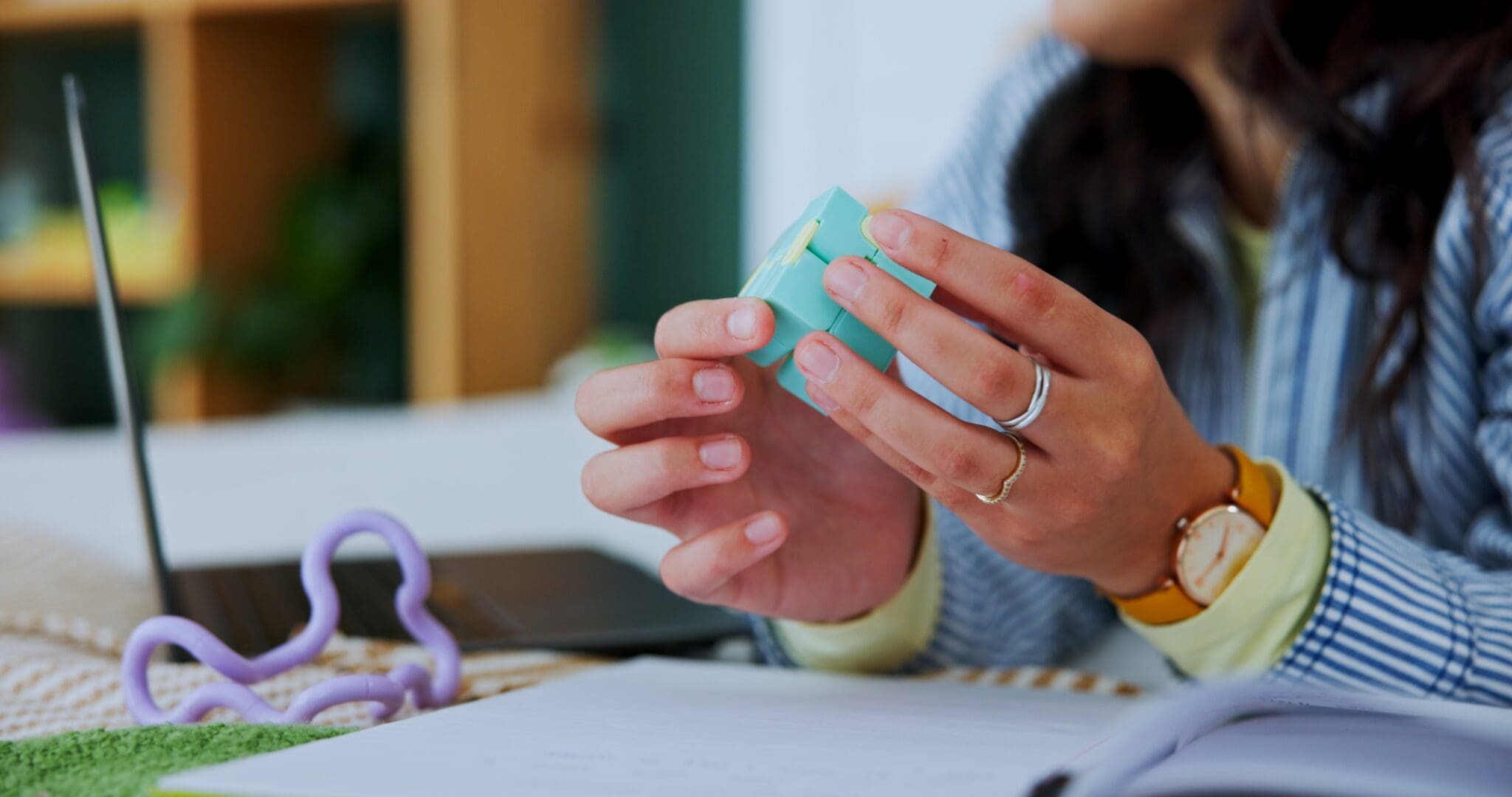
A grounding object is a small item you can hold or touch when you feel anxious, overwhelmed or disconnected. It works by giving your senses a stable point of focus. It also acts as a cue: “I know what to do when I feel like this.”
What makes a good grounding object:
- It is small and easy to carry.
- It has a distinct texture, shape or temperature.
- It is safe to use in public without drawing attention.
- It feels neutral or comforting to you.
Ideas that work well for many people:
- A smooth stone or worry pebble.
- A keyring with ridges or a textured charm.
- A hair tie or elastic band to roll between your fingers.
- A coin with an interesting edge.
- A small piece of fabric with a strong texture.
- A lip balm with a clear scent.
- A sachet of peppermint tea in your bag to smell.
How to use it effectively: instead of just holding it, engage with it actively. Describe it, trace its edges, press it into your palm, and pair it with a slow exhale. If you tend to forget to use tools when anxious, attach the object to something you always carry, such as keys or a lanyard.
Grounding Techniques for Social Anxiety
Social anxiety often involves fear of judgement, embarrassment or being ‘seen’ in a negative way. It can show up as racing thoughts before events, blanking in conversation, a tight throat, sweating or replaying interactions afterwards.
Grounding can help in two key moments: before and during social situations.
Before a social situation
Try a 2-minute preparation:
- Feel your feet on the floor and slow your exhale.
- Name the situation factually: “I am meeting two friends for coffee.”
- Set one realistic goal: “Stay for 30 minutes” or “Ask one question”.
- Remind yourself: “Anxiety is uncomfortable, not dangerous.”
During conversation
Choose a discreet anchor:
- Notice the sensation of your feet in shoes.
- Hold a glass and feel its coolness.
- Gently press your fingertips together under the table.
- Listen for one specific sound in the room between sentences.
If you start overthinking what to say, shift attention to listening. Notice the other person’s words, tone and facial expression. Listening is grounding because it pulls you out of self-monitoring.
After the event
Social anxiety often continues with replaying. A helpful grounding step is to anchor back to the present: “That conversation is over. I am home now. My body is still activated, and it will settle.” Then do something sensory like a shower, a walk or a meal.
For support and information on anxiety and panic, Mind and Anxiety UK both have practical resources.
Grounding vs Mindfulness: Key Differences
Grounding and mindfulness overlap, yet they are not the same, and knowing the difference can reduce frustration.
Grounding is often a short-term stabiliser. It is designed to help when anxiety spikes, when you feel dissociated or when you are overwhelmed. It usually involves orienting to external reality or strong sensory cues. It is often practical and active.
Mindfulness is often a longer-term practice. Mindfulness is the skill of noticing thoughts, feelings and sensations without judgement. It can include meditation. For some people, mindfulness feels calming. For others, particularly those with trauma histories, sitting quietly with sensations can be difficult at first.
A simple way to tell which you need:
- If you feel flooded, panicky or unreal, start with grounding.
- If you feel steady enough to observe and allow, mindfulness may help.
You can also combine them. For example, you might ground first (feet on floor, describe the room), then do a brief mindful check-in (notice breath, notice thoughts passing).
If you want a reputable introduction to mindfulness and when it may help, NHS guidance on mindfulness is a good resource.
Grounding Practice Plan and Checklist
Grounding works best when it becomes familiar. In high anxiety, your thinking brain can feel harder to access, so you need tools that feel automatic. That is why practising when calm matters. It is similar to learning a route before you need to drive it in fog.
Step 1: Build your personal toolkit
Choose 6 techniques total:
- 2 sensory techniques (e.g. 5-4-3-2-1, grounding object).
- 2 body techniques (e.g. feet press, muscle relaxation).
- 1 breathing technique (e.g. box breathing or long exhale).
- 1 cognitive technique (e.g. describe the room, count backwards).
Write them in your phone notes, using short prompts like “Feet, exhale, name 5 objects”.
Step 2: Match tools to settings
Different situations need different tools. Create a simple map:
- At work: Toe press, pen texture, slow exhale.
- On public transport: 5-4-3-2-1 silently, grounding object, count backwards.
- At night: Body scan, long exhale, neutral list task.
- During conflict: Feel feet, slow exhale, name three objects.
Step 3: Practise when calm
Do one technique once a day for a week. Keep it short. The goal is consistency.
A simple weekly plan:
- Monday: 5-4-3-2-1 (2 minutes).
- Tuesday: box breathing (2 minutes).
- Wednesday: muscle tension and release (3 minutes).
- Thursday: body scan (3 minutes).
- Friday: grounding object practice (1 minute).
- Saturday: describe the room (2 minutes).
- Sunday: choose your favourite and repeat.
Step 4: Use it at the early warning signs
Grounding is often most effective at the beginning of anxiety. Early signs can include:
- Tight chest or throat.
- Racing thoughts.
- A sense of urgency.
- Feeling irritable or snappy.
- A sudden urge to escape.
- Feeling unreal or foggy.
When you notice early signs, do a short grounding exercise immediately. Even 30 seconds can prevent escalation.
Step 5: Know when to seek further support
Grounding is a tool, not a full treatment. If anxiety is persistent, worsening or affecting work, relationships or sleep, it may be time to seek professional help.
In the UK, options include:
- Speaking to your GP about symptoms and support.
- Self-referring to NHS talking therapies, where available in England.
- Finding a qualified private therapist via the BACP therapist directory.
- Accessing support and information through Mind or Anxiety UK.
If you are struggling to stay safe or you need someone to talk to urgently, you can contact Samaritans.
Grounding checklist (save this)
Use this as a quick reference:
- I can name what is happening: “This is anxiety.”
- I can anchor to the present: feet, chair, room.
- I can lengthen my exhale for three breaths.
- I can use one sensory tool: 5-4-3-2-1 or an object.
- I can take one small next step.
- If symptoms persist, I will seek support.
Conclusion
Anxiety can make the present feel unsafe, even when you are not in danger. Grounding techniques help by bringing you back to what is real and immediate, signalling safety to your nervous system, and reducing the momentum of spiralling thoughts and panic symptoms. They are not about forcing happiness or pretending everything is fine. Instead, they are about stabilising long enough to think clearly and care for yourself.
The most effective approach is personal. Some people settle through breath. Others need sensory anchors, movement or cognitive tasks. Therefore, build a small toolkit that fits your life and practise it when calm, so it is available when you are under pressure. If anxiety is persistent, disruptive or linked to dissociation, intrusive thoughts or frequent panic, you deserve more support than self-help alone. UK routes through your GP, NHS services and reputable charities can help you find steadier ground and feel more in control over time.